[News] Zernio Pricing: What the Free Tier Actually Covers
- Free tier: Yes
- Cheapest paid plan: US$6/mo and up
- Free quota: (2026-11-12 direct read of official pricing page) The first 2 linked …
- Last checked: 2026-11-19
Article last updated: 2026-11-13


Zernio just moved from an unverified draft to a live, checked entry in our database. The pricing page was read directly on 2026-11-12, and the numbers are now public. This is a usage-priced social media API — a tool that lets software talk to social platforms without a human clicking buttons. You use one API (an interface that lets your own code send and receive data) to schedule posts, publish them, pull analytics, run a DM inbox, manage ads, and handle phone and SMS channels. The people who care are developers and marketing teams wiring social posting into n8n, AI agents, or their own apps.
Here is the angle: Zernio’s free tier is not a trial. It is a permanent free layer with real monthly quotas, and the paid side is priced per connected account, not per seat. That combination changes who should sign up and who should walk away.
What the free tier actually hands you
Two connected social accounts, free, no credit card. Every feature works on every account — there are no feature tiers, no “Pro-only” analytics, no locked inbox. That is unusual. Most social tools split features by plan; Zernio splits by account count.
On top of the accounts, three monthly quotas sit at the free level: the first 10,000 DMs per month, the first 2,000 automation runs per month for new accounts, and the first 500 managed ads. Anything past those runs on usage pricing, which the official page does not itemize.
Read that carefully. The free tier is not “2 accounts and nothing else.” It is 2 accounts plus a DM allowance large enough for a small support operation, plus enough automation runs to keep a modest workflow alive, plus 500 ads. For a solo operator or a two-brand side project, this may be the whole product.
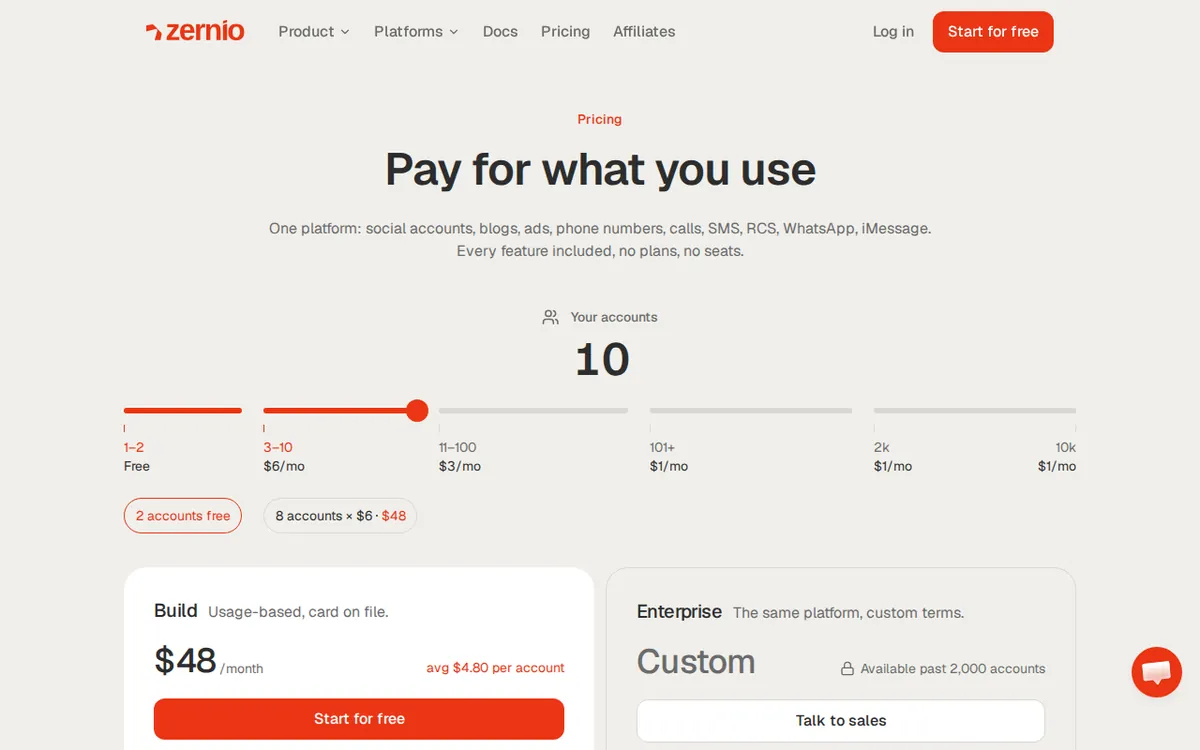
Figure: zernio.com official pricing page, captured 2026-11-13.
The per-account price ladder, and why it bends
Paid pricing is tiered by how many social accounts you connect:
- Accounts 3 through 10: US$6 per account per month. The official example: 10 accounts runs about US$48/month.
- Accounts 11 through 100: US$3 per account per month. Official examples: 20 accounts about US$78/month, 100 accounts about US$318/month.
- Accounts 101 and up: US$1 per account per month. Official example: 1,000 accounts about US$1,218/month.
Notice the shape. The per-account price halves at account 11 and drops again at account 101. This is volume pricing that rewards scale hard. An agency with 100 client accounts pays US$3 each; a platform with 1,000 pays US$1 each. But a small team with 5 accounts pays US$6 each — the most expensive per-account rate on the board.
There is also an Enterprise custom plan. Zernio does not publish its price. We are not going to guess it.
One thing the data does not contain: any annual price. Every figure here is monthly. If you want a yearly number, the pricing page is where to look, because we will not multiply monthly rates into a total that Zernio never quoted.
Prices can vary by country; we checked from Taiwan.
Where the free tier stops being free
The quotas are the real boundary, not the account count. Cross 10,000 DMs in a month, or 2,000 automation runs, or 500 managed ads, and usage pricing kicks in. The official page does not publish those overage rates, so we cannot tell you what the next DM costs. That is a genuine gap, and it matters most for high-volume DM operations — support desks, lead-gen funnels, anything that treats the inbox as a primary channel.
The 2,000 automation runs also carry a condition: the data says “new accounts.” Whether that allowance persists for older accounts is not spelled out on the page we read. Treat it as a launch-period number until Zernio says otherwise.
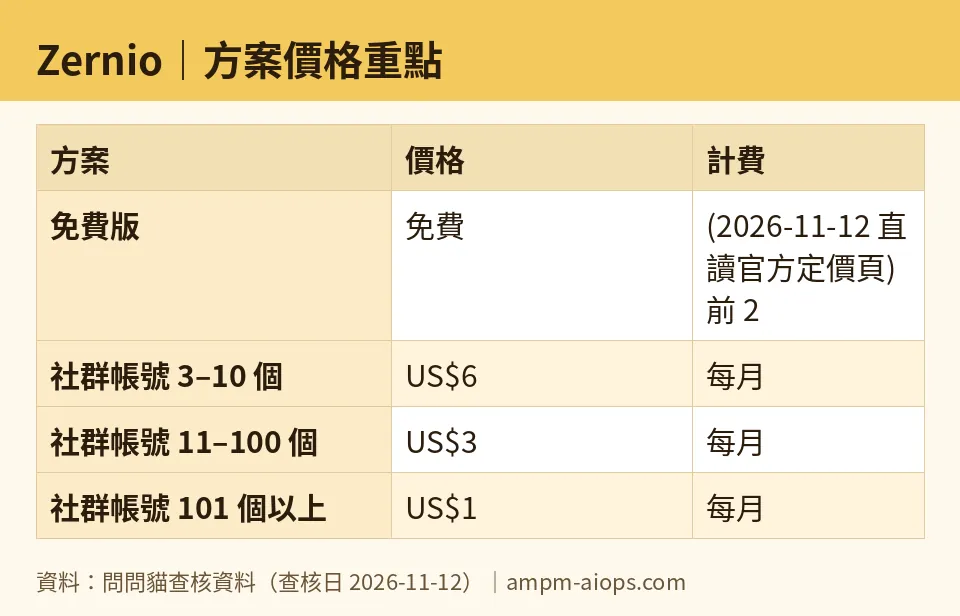
Figure: compiled by AMPM from its verified data (last verified 2026-11-12).
🔍 AMPM exclusive check
Nothing differed from the official page this time; every number below matches it, checked 2026-11-12. What we can add is context the pricing page does not spell out.
First, this entry was only recently verified. The internal record shows the tool was added as a challenger candidate with pricing, free plan, and language support all unverified, then moved to active status on 2026-11-12 after a manual read of the official pricing page. That means the numbers are fresh but have been through one verification round, not the three-way manual cross-check we run on established tools. The free quotas and commercial terms should be confirmed against the live page before you commit money.
Second, the pricing page gives worked examples at 10, 20, 100, and 1,000 accounts but not at the awkward middle — 3, 5, or 15 accounts. If you are pricing a small rollout, you will have to do that arithmetic yourself against the per-account rates. We will not do it for you, because the official page only quotes the examples above.
Third, the free tier’s three quotas are described as monthly and separate from the account allowance. A reader skimming might assume the 10,000 DMs are shared across the 2 free accounts. The page does not say per-account or pooled. That ambiguity is worth a support ticket before you build a workflow that depends on it.
☀️ AMO, the budget-minded cat

AMO’s question is always the same: is free enough, and is paying worth it?
For Zernio, the free tier is genuinely generous on paper. Two accounts, every feature, no card. 10,000 DMs a month is not a sample size — it is a working inbox for a small brand. 2,000 automation runs is enough to run a posting schedule, a comment responder, or a lead router without touching a paid tier. 500 managed ads covers a modest campaign test.
So AMO’s first answer: if you run one or two brands and your DM volume stays under 10,000 a month, you may never pay Zernio anything. That is rare, and it is worth testing before you assume you need a plan.
AMO’s second answer is where the budget math bites. The moment you add a third account, you jump to US$6/month for that account — and the rate stays at US$6 all the way to account 10. A five-account operator pays US$6 each, which is the worst per-account rate Zernio offers. If you are a small agency with a handful of client accounts, you are subsidizing the volume discount that bigger users get.
The break-even logic is simple. Stay at 2 accounts and the product is free. Go to 3 and you are paying US$6/month for the privilege of one more account. Go to 11 and the marginal account costs US$3. Go to 101 and it costs US$1. AMO would tell a two-account user to stay put and a hundred-account platform to sign immediately. The uncomfortable zone is 3 to 10 accounts, where you pay the most per account for the least scale.
AMO would also flag the unpublished overage rates. Free is only free until you cross a quota, and Zernio has not told us what happens then. For a budget-minded user, an unknown overage price is a risk, not a feature. Cap your DM and automation usage, watch the counters, and ask support for the overage schedule before you scale.
Verdict: who should use it, who should skip it
Use Zernio if you run one or two social accounts and want every feature without a credit card. The free tier is a real product, not a teaser, and the DM and automation quotas are large enough for a small operation to run indefinitely.
Use it and pay if you manage 11 or more accounts. The US$3 and US$1 per-account rates are aggressive, and the volume examples — 100 accounts at about US$318/month, 1,000 at about US$1,218/month — show the pricing is built for scale.
Skip it, or wait, if you sit in the 3-to-10 account range and are price-sensitive. You pay the highest per-account rate on the board, and the free tier’s two accounts may cover you better than a US$6-per-account upgrade.
Skip it if your operation lives on DM volume. The 10,000 monthly DM allowance is generous, but the overage price is unpublished, and building a high-volume inbox on an unknown rate is a budget gamble.
And confirm the terms yourself before you commit. This entry has been through one verification round, not three. The numbers match the official page as of 2026-11-12 — but the page is the source of truth, not us.
Written: 2026-11-13 Price last verified: 2026-11-12 Tool last health-checked: 2026-11-12
🔗 Related on AMPM
📎 Sources
All prices and quotas in this article come from AMPM’s verified dataset for Zernio (last verified 2026-11-12); primary sources:
🐾 Meet the cats: AMO and PIMI
AMPM is a Taiwan-based AI-tool pricing watchdog. Our motto: ask before you subscribe. Two cats argue every tool from two sides:
- ☀️ AMO — the budget-minded cat. Always asks: is the free tier enough, and is paying actually worth it?
- 🌙 PIMI — the performance-minded cat. Cares about whether it works well, fast, and gets your job done.
When they are done arguing, you know whether to pay. Every number is checked by us, with the verification date at the end.
🐾 Our sister sites also checked
Read next
- Zernio Full breakdown: pricing, features and real-world limits
- Zernio Alternatives
- Free plan limits for every AI tool we track