[Review] Tilda Publishing Pricing: Is the Free Plan Enough for Client Work?
- Free tier: Yes
- Cheapest paid plan: US$15/mo and up
- Free quota: Free plan: 1 website, up to 50 pages, 50 MB storage, only the tilda.ws …
- Last checked: 2026-11-19
Article last updated: 2026-11-10


The free plan looks generous until you try to charge money for the site you built. Tilda Publishing is a block-based website builder — you stack pre-made sections instead of writing code — and its free tier gives you a real site on a real subdomain. What it does not give you is a custom domain, working forms, or any way to take payment. That single gap decides whether Tilda is a hobby tool or a business tool, and it is the reason most freelancers end up on a paid plan within a week.
This review reads the verified pricing data, not a demo account. Every number below comes from Tilda’s own pricing page, checked on 2026-11-09. Prices vary by country; we checked from Taiwan.
What the free plan actually hands you
Free gets you one website, up to 50 pages, and 50MB of storage. You build on a tilda.ws subdomain — that is the address Tilda owns, not yours. Basic blocks are available; the full block library is not.
The three missing pieces matter more than the page count. No custom domain means your site lives at something like yourname.tilda.ws forever. No form data connection means a contact form can look finished and still not deliver submissions anywhere useful. No online payments means you cannot sell a single thing through the site.
Fifty pages is a lot for a portfolio. It is nothing for a store, a course, or a content site that grows. And 50MB of storage fills faster than people expect once images and video embeds pile up.
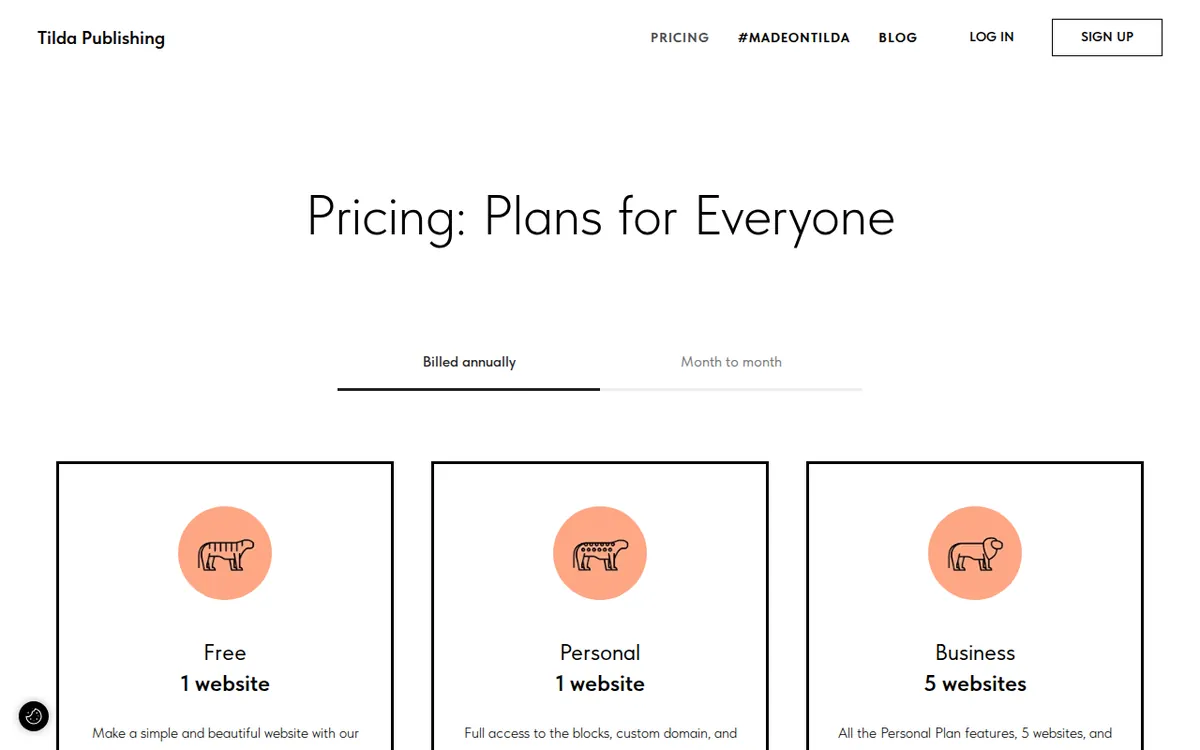
Figure: tilda.cc official pricing page, captured 2026-11-10.
The paid jump, and where it stops making sense
Personal runs US$15/month billed monthly, or US$10/month if you pay yearly — US$120 for the year. That buys one website, up to 500 pages, 1GB of storage, a custom domain, the full block module library, and form connections. This is the plan that turns Tilda from a toy into something you can bill a client for.
Business runs US$25/month billed monthly, or US$20/month yearly — US$240 for the year. It covers up to 5 websites, each with 500 pages and 1GB of storage, and adds static code export and API integration on top of everything in Personal.
Here is the part worth pausing on. The storage number does not move between the two paid tiers. Personal gives 1GB. Business gives 1GB per site. If your problem is media weight, paying more does not solve it — you just get more sites with the same ceiling. The real reason to step up is the 5-site limit or code export, not capacity.
There is no published yearly price for anything beyond what is listed here, and no lifetime option in the data. Monthly billing costs more per month than yearly billing on both plans; that is the trade for not committing.
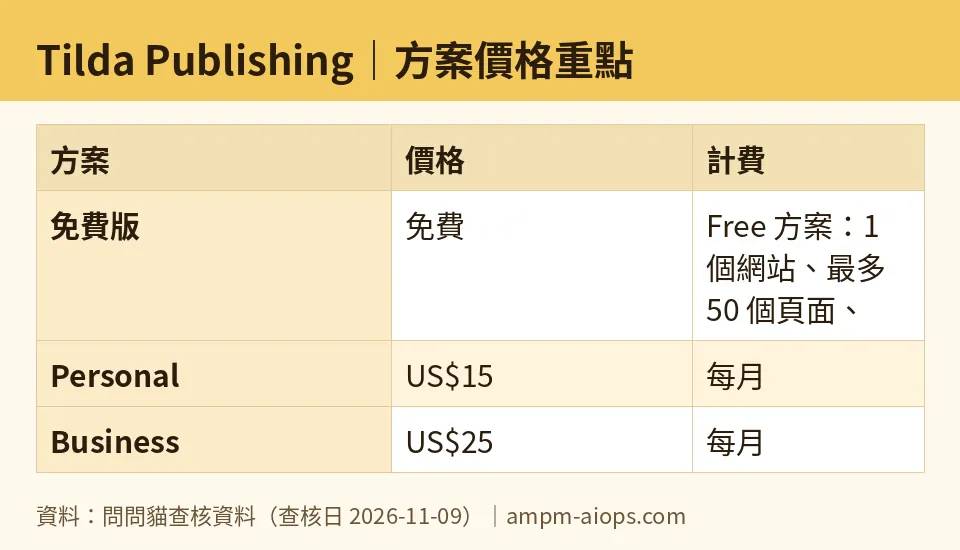
Figure: compiled by AMPM from its verified data (last verified 2026-11-09).
🔍 AMPM exclusive check
Nothing differed from the official page this time; every number below matches it, checked 2026-11-09. The free tier, the page counts, the storage figures, and both paid prices were read directly from Tilda’s pricing page and cross-referenced against a third-party listing.
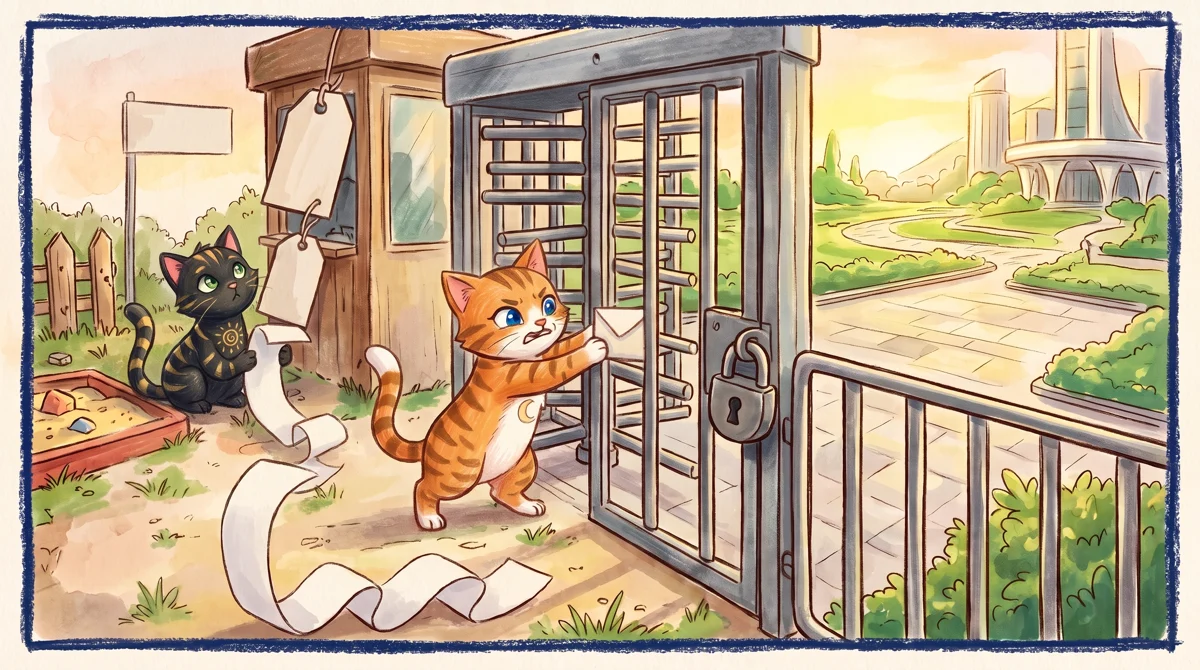
Illustration: The free tier strictly locks out custom domains and contact forms, leaving no choice but to pay the toll for a professional web presence.
One thing the vendor page does not spell out: the free plan’s limits are not just caps, they are feature locks. A 50-page site with no custom domain and no form connection is not a smaller version of a paid site — it is a different product. The pricing page lists what free includes; it does not frame how much of a working business site is missing. That framing is ours, and it is the reason this review exists.
We also note the data carries a caution flag: this tool was checked in a single automated pass, not a three-way manual cross-check. Treat the free-tier terms and commercial-use conditions as current-as-of the check date and confirm them on the official page before you commit money.
☀️ AMO, the budget-minded cat

The free plan is genuinely usable for one narrow job: a personal portfolio or a single landing page you never intend to monetize. One site, 50 pages, 50MB, tilda.ws subdomain. If that describes your project, you can build it and pay nothing, and nobody will stop you.
The moment money enters the picture, free collapses. No custom domain means no professional address. No form connection means no leads. No online payments means no sales. Any one of those three kills a client project on its own.
So the real budget question is whether US$15/month is worth it. Compare it to the yearly rate: US$10/month, US$120 for the year. If you are paying monthly for twelve months, you are spending more than the yearly price for the same plan — the data does not give a yearly total for monthly billing, but the per-month gap is right there. If you know you need it for a year, yearly is the cheaper path.
Is US$15/month a lot? For a freelancer billing one client site, no. For someone who wants a blog with a custom domain and nothing else, it is more than the job needs. Free is enough only if you never need a domain, forms, or payments. Almost nobody building for money fits that description.
🌙 PIMI, the performance-minded cat
Performance here is about whether the tool does the job well, and the plan structure tells you where Tilda expects you to land.
Personal at US$15/month monthly or US$10/month yearly gives 500 pages, 1GB, custom domain, full block library, and form connections. That is a complete working setup for one site. The page ceiling is ten times the free tier, which covers most brochure sites, portfolios, and small content operations without strain.
Business at US$25/month monthly or US$20/month yearly adds 5 sites, code export, and API integration. Code export matters if you want to host the static output somewhere else or hand clean files to a developer. API integration matters if the site has to talk to other systems. If neither applies, Business is paying for sites you may not need.
The weak point is storage. 1GB on Personal, 1GB per site on Business. Media-heavy sites will hit that wall, and no higher tier in the data lifts it. If your build is image- or video-heavy, budget for hosting media elsewhere and embedding it.
The yearly discount is the strongest performance-per-dollar move: US$10/month versus US$15/month on Personal, US$20/month versus US$25/month on Business. Same features, lower rate, one commitment.
Verdict: who should use it, who should skip it
Use the free plan if you are building one personal site, you do not need a custom domain, and you will never take a form submission or a payment. That is a real use case and it costs nothing.
Pay for Personal if you need a custom domain, working forms, and the full block library on one site. US$15/month monthly or US$10/month yearly is the honest entry price for professional work, and the yearly rate is the better deal if you are staying a year.
Step up to Business only if you need multiple sites, code export, or API integration. US$25/month monthly or US$20/month yearly. Do not upgrade for storage — it does not increase.
Skip Tilda entirely if your site is media-heavy and will blow past 1GB, or if you need a free tier that supports a custom domain and payments. Tilda’s free plan does neither, and no plan in this data fixes the storage ceiling.
Written: 2026-11-10 Price last verified: 2026-11-09 Tool last health-checked: 2026-11-10
🔗 Related on AMPM
📎 Sources
All prices and quotas in this article come from AMPM’s verified dataset for Tilda Publishing (last verified 2026-11-09); primary sources:
🐾 Meet the cats: AMO and PIMI
AMPM is a Taiwan-based AI-tool pricing watchdog. Our motto: ask before you subscribe. Two cats argue every tool from two sides:
- ☀️ AMO — the budget-minded cat. Always asks: is the free tier enough, and is paying actually worth it?
- 🌙 PIMI — the performance-minded cat. Cares about whether it works well, fast, and gets your job done.
When they are done arguing, you know whether to pay. Every number is checked by us, with the verification date at the end.
🐾 Our sister sites also checked
Read next
- Tilda Publishing Full breakdown: pricing, features and real-world limits
- Tilda Publishing Is the free quota enough?
- Tilda Publishing Alternatives
- Free plan limits for every AI tool we track