[Pricing] Sunsama Pricing: Is There a Free Tier, or Just a Trial Before You Pay?
- Free tier: No
- Cheapest paid plan: US$22/mo and up
- Free quota: No permanent free plan, provides a 14‑day full‑feature free trial (no …
- Last checked: 2026-11-19
Article last updated: 2026-11-19



Sunsama is a daily planner built around one idea: you should decide what you can actually finish today, not stare at a list of 200 tasks. It calls itself an AI timeboxing calendar — timeboxing means giving each task a fixed slot on your day, so the calendar shows what fits and what does not. The tool also leans on daily rituals: a morning planning session, an evening shutdown, a weekly review.
That philosophy is the whole product. And it is also the whole pricing story, because Sunsama does not sell features in tiers. It sells one plan, at one price, to one person at a time. There is no cheaper tier to graduate to, no team bundle to split, no add-on to buy later. You either pay the single rate or you stop using it.
So the real question is not “which plan.” It is whether a single-price tool with no permanent free version can earn its spot in your stack. Here is what the numbers actually say.
One plan, two billing rhythms
Sunsama’s paid plan is called Pro. It costs US$22 per person per month on monthly billing. Switch to annual billing and it becomes US$204 per person per year, which works out to US$17 per month. Both figures come straight from the vendor’s pricing page, checked 2026-11-16.
That is the entire price list. No Basic tier, no Pro Plus, no Enterprise quote. If you want Sunsama, you pay Pro pricing, and the only decision left is monthly versus annual.
The annual route saves money per month, but it front-loads the commitment. Monthly billing keeps you flexible at a higher rate. That trade — flexibility versus a lower effective rate — is the only pricing lever Sunsama gives you.
What does Pro include? The full daily scheduling flow, weekly review, workload warnings when you overbook yourself, the Sunny AI assistant, and integrations with Google Calendar, Outlook Calendar, Notion, Jira, Asana, Slack, Trello, Linear, and GitHub. There is no stripped-down version missing the AI or missing the integrations. Everything the product does sits behind the same US$22 / US$204 wall.
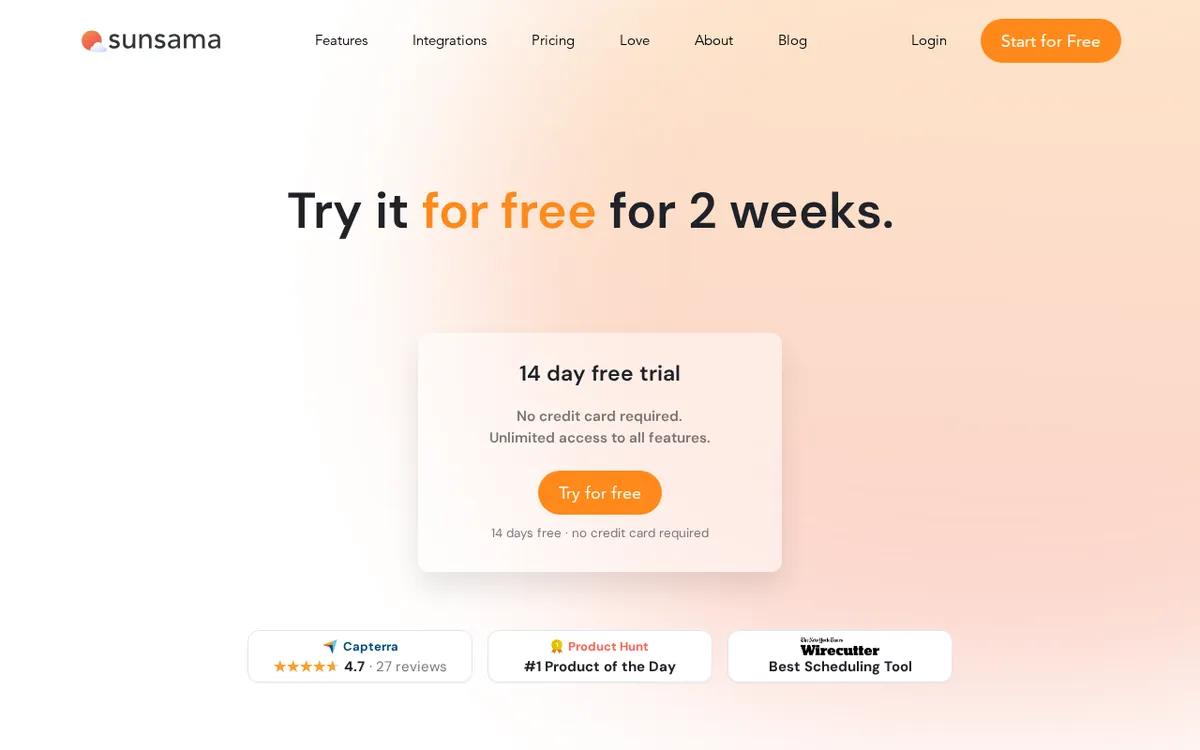
Figure: sunsama.com official pricing page, captured 2026-11-19.
The free question has a short answer
Sunsama has no permanent free tier. None. What it offers instead is a 14-day free trial with full functionality, and it does not require a credit card to start.
That last detail matters more than it looks. A no-card trial means you can test the full product without a payment method on file, and you will not get charged automatically when the 14 days run out. You have to actively decide to pay. That is a cleaner setup than trials that silently convert.
But 14 days is 14 days. When the trial ends, the tool stops. There is no free mode to fall back into, no read-only view, no limited free seat. If you have built your mornings around Sunsama and you do not pay, you lose access to the thing you built.
This is the single most important fact for anyone comparing planners. Many competitors in this category keep a free tier alive forever, even a thin one. Sunsama does not. Its trial is a test drive, not a destination.
Where the price sits against the job
US$22 per month puts Sunsama in the premium bracket for a personal planner. That is not a hidden cost or a surprise — it is the advertised rate. But it does mean the tool has to replace something, or fix something, to justify itself.
The workload warning feature is the clearest example of what you are paying for. Most calendars let you pile tasks onto a day until the day is impossible. Sunsama flags the overload and pushes back. If your problem is chronic overcommitment, that nudge is the product. If your problem is just “I forget things,” a cheaper or free tool handles it.
The integrations list is also doing real work here. Google Calendar, Outlook, Notion, Jira, Asana, Slack, Trello, Linear, GitHub — that is a wide net for a single-plan tool. Pulling tasks from Jira and Linear into a daily plan is a specific, valuable job. If you live in those tools, the integration depth is part of what the US$22 buys.
If you do not, you are paying premium pricing for a daily planner, and the math gets harder.
🔍 AMPM exclusive check
Nothing differed from the official page this time. Every number in this article — US$22 monthly, US$204 annually, the US$17 per month effective rate, the 14-day trial, the no-credit-card detail, and the full feature list — matches what the vendor’s pricing page showed when we read it on 2026-11-16.
One caveat worth stating plainly: this tool was checked once, by automated read, and has not yet gone through our full three-way manual cross-check. The free-trial terms and commercial-use conditions should be confirmed on the official site at the moment you sign up, because vendors change trial rules without changing the headline price.
Prices can also vary by country. We checked from Taiwan; your local rate may differ.
☀️ AMO, the budget-minded cat

Here is the budget problem in one line: there is no free version to be satisfied with. Usually I can tell you whether the free tier is enough. With Sunsama, the free tier does not exist, so the question becomes whether 14 days is enough time to know if US$22 a month is worth it.
Fourteen days is a real trial, not a demo. Full features, no card required. If you plan carefully, you can run two full weekly reviews inside that window — the weekly review is the feature that separates Sunsama from a plain to-do list, so test it twice before you decide. You can also deliberately overload a day and see whether the workload warning actually changes your behavior. If it does not, you have your answer for free.
The cheapest way in is annual billing: US$204 per year, which the vendor presents as US$17 per month. That is the lowest rate available, and there is no cheaper tier below it. But annual means paying the full US$204 up front, and if you quit in month three, you have spent more than three months of monthly billing would have cost. Monthly at US$22 keeps the exit cheap while you are still deciding.
When is paying not worth it? If your task list is short, if you do not overcommit, or if a free planner already keeps your day honest — skip it. Sunsama is not fixing a problem you do not have. The trial will tell you in two weeks, and it costs nothing to find out.
🌙 PIMI, the performance-minded cat

Performance here is not about speed. It is about whether the daily ritual actually holds up when your day gets messy. And the feature list is aimed exactly at that: full daily scheduling, weekly review, workload warnings, the Sunny AI assistant, and nine named integrations including Google Calendar, Outlook Calendar, Notion, Jira, Asana, Slack, Trello, Linear, and GitHub.
The integration breadth is the strongest performance signal. A planner that can pull from Jira, Linear, and GitHub alongside your calendar is doing real work, not just displaying tasks you typed in yourself. If your work lives across those tools, Sunsama is aggregating your day in one place, and that is a job worth paying for.
The workload warning is the second signal. A planner that tells you “this day does not fit” is doing something a calendar cannot. Whether that warning is smart enough to trust is exactly what the 14-day trial is for — overload a day on purpose and watch what it says.
The honest limit: one plan means no performance tier to climb. You get everything or nothing. There is no cheaper version missing the AI, and no premium version with more. At US$22 monthly or US$204 annually, you are buying the full product on day one. If the AI assistant or the integrations underdeliver for your workflow, there is no fallback plan to downgrade to. Test the specific features you care about inside the trial window, because after 14 days the only options are pay in full or walk away.
Verdict: who should use it, who should skip it
Use Sunsama if you chronically overcommit and want a tool that pushes back, if your work is spread across Jira, Linear, GitHub, Notion, and your calendar, and if you will actually use the daily and weekly rituals. The 14-day no-card trial lets you test all of that at no cost, and annual billing at US$204 per year brings the effective rate to US$17 per month.
Skip it if you want a free planner, if your task list is manageable without workload warnings, or if you need a cheap entry tier before committing. There is no free tier and no lower plan — the only choice is US$22 monthly versus US$204 annually, and if neither fits, the tool is not for you.
Written: 2026-11-19 Price last verified: 2026-11-16 Tool last health-checked: 2026-11-19
🔗 Related on AMPM
📎 Sources
All prices and quotas in this article come from AMPM’s verified dataset for Sunsama (last verified 2026-11-16); primary sources:
🐾 Meet the cats: AMO and PIMI
AMPM is a Taiwan-based AI-tool pricing watchdog. Our motto: ask before you subscribe. Two cats argue every tool from two sides:
- ☀️ AMO — the budget-minded cat. Always asks: is the free tier enough, and is paying actually worth it?
- 🌙 PIMI — the performance-minded cat. Cares about whether it works well, fast, and gets your job done.
When they are done arguing, you know whether to pay. Every number is checked by us, with the verification date at the end.
🐾 Our sister sites also checked
Read next
- Sunsama Full breakdown: pricing, features and real-world limits
- Sunsama Is the free quota enough?
- Sunsama Alternatives
- Free plan limits for every AI tool we track