[Review] Ollama Pricing: Free Tier vs Paid Cloud Plans Worth It?
- Free tier: Yes
- Cheapest paid plan: US$20/mo and up
- Free quota: Locally, it runs completely free on personal hardware with no call …
- Last checked: 2026-11-19
Article last updated: 2026-11-08


Ollama is a tool for running open-source large language models — AI models you download and run yourself — on your own computer or through Ollama’s cloud. It also offers an OpenAI-compatible API interface, meaning code written for OpenAI’s API can point at Ollama instead with minimal changes. The pitch is appealing: run models locally for free, or pay for cloud capacity when your hardware can’t keep up.
The problem is that Ollama’s free tier is actually two different things, and the paid plans sit in an awkward middle ground. Local use is genuinely unlimited. Cloud use is not. And the jump from free cloud to Pro costs US$20 monthly — but what you get for that money deserves scrutiny.
Here are the three things that stand out after reading every verified number.
The Free Tier Is Two Products Wearing One Name
Ollama’s free offering splits into local and cloud, and they behave nothing alike.
Local: run models on your own hardware, completely free, with no call limit. No concurrency cap. No token meter. Your GPU, your rules.
Cloud Free: a small lightweight quota for starter models, plus 1 concurrent request. That’s it. One request at a time. If you’re building anything that needs parallel calls — a chatbot handling multiple users, a batch job, an agent making simultaneous tool calls — one concurrent request becomes a wall fast.
The word “free” covers both, but they serve different people. If you have a capable machine, local free is the real product. Cloud Free is a taste, not a meal.
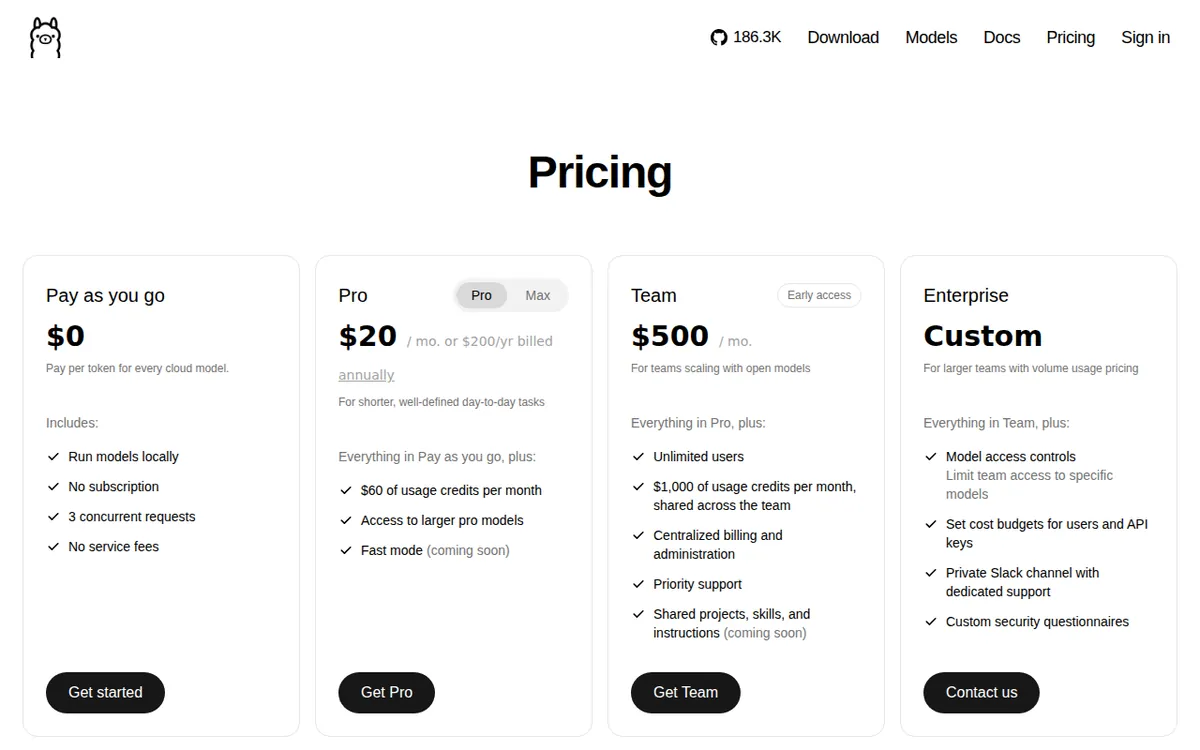
Figure: ollama.com official pricing page, captured 2026-11-08.
The Paid Plans: Credits, Concurrency, and What US$20 Actually Buys
Ollama’s paid tiers are Pro at US$20 monthly (US$200 yearly), Max at US$100 monthly, and Team at US$500 monthly.
Pro includes US$60 in monthly token usage credit, 3 concurrent cloud models, and overage billed at token list price. Max includes US$300 in monthly token credit and 10 concurrent models. Team includes unlimited member seats, US$1,000 in shared monthly token credit, and a centralized admin console.
Tokens are the units AI models process — roughly, pieces of words going in and coming out. Credits are prepaid usage allowances measured in dollars.
Notice what the plans actually sell: concurrency and credit. Not model access. Not features. The free tier already lets you run models locally without limit. Paying moves you to Ollama’s cloud, where you get a dollar-denominated credit pool and a concurrency ceiling.
Pro’s US$60 credit against a US$20 bill looks generous until you realize overage kicks in at token list price. Heavy users burn through credits. The concurrency cap of 3 is the harder limit for anything production-adjacent.
What Ollama Does Well
Local inference with no call limit is the strongest offer here. No other number in this data matches it. You download models, run them on your hardware, and Ollama never meters you. For privacy-sensitive work, offline use, or experimentation, that’s real value.
The OpenAI-compatible API means switching costs are low. Existing code often works with a URL change.
The tier structure is also clean. Three paid plans, clear concurrency numbers, clear credit amounts. No hidden feature gates in the data we verified.
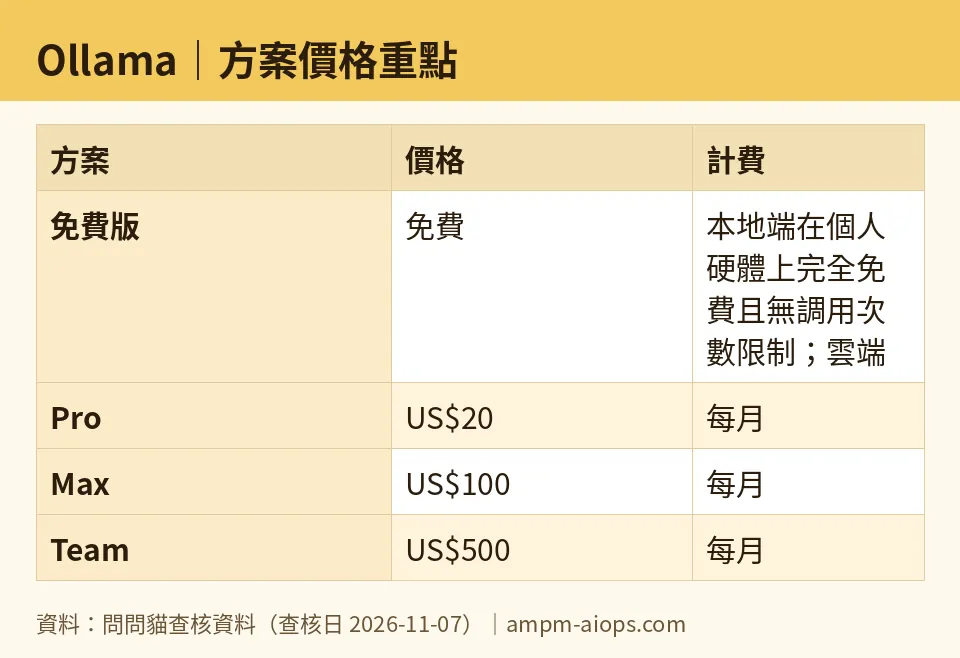
Figure: compiled by AMPM from its verified data (last verified 2026-11-07).
🔍 AMPM exclusive check
Nothing differed from the official page this time; every number below matches it, checked 2026-11-07.
One caveat from our records: this tool was flagged as an auto-ingested challenger candidate. The data went through one verification round, not three-way manual cross-checking. Free quotas and commercial terms should be confirmed against the official site at the moment you read this. Our verification history shows daily automated checks from 2026-11-02 through 2026-11-07, all confirming no changes. But automated checks aren’t the same as human cross-verification, and we’re saying so plainly.
Prices vary by country; we checked from Taiwan.
☀️ AMO, the budget-minded cat

The budget question with Ollama isn’t “is free enough” — it’s “which free.”
Local free is unlimited. No call cap, no concurrency limit, no token meter. If you own hardware that can run the models you need, you never pay Ollama anything. That’s not a trial. That’s a complete product at no cost.
Cloud Free is different. One concurrent request and a small lightweight quota for starter models. For solo tinkering — asking a model questions, testing prompts, learning the API — that might stretch further than you’d expect. For anything with two users hitting it at once, it breaks immediately.
Now the paid math. Pro costs US$20 monthly and includes US$60 in token credit. If you’d spend more than US$60 on tokens anyway, the credit alone exceeds the subscription price. But that logic only works if you’re already committed to cloud usage at volume. Most budget users aren’t.
Max at US$100 monthly with US$300 credit follows the same pattern — the credit is three times the price. Team at US$500 monthly with US$1,000 shared credit doubles it.
The budget verdict: if local works for you, pay nothing and ignore the cloud tiers entirely. If you need cloud, Pro’s credit-to-price ratio is the entry point, but US$20 monthly is still US$20 monthly. Don’t subscribe for the credit alone — subscribe because you need concurrency above 1 and your hardware can’t do the job.
🌙 PIMI, the performance-minded cat

Performance here means two things: does it work well, and does it work fast enough.
Local performance depends entirely on your hardware. Ollama doesn’t control that. What Ollama controls is the cloud side, and the concurrency numbers tell the real story.
Cloud Free: 1 concurrent request. That’s a single-lane road. Any workload with parallel calls — multiple users, batch processing, agent frameworks that fire several requests at once — queues behind that one lane. For a demo, fine. For real use, painful.
Pro: 3 concurrent models. Better, but still modest. Three simultaneous requests is enough for a small team or a low-traffic app. It is not enough for anything scaling.
Max: 10 concurrent models. This is where cloud becomes usable for production-adjacent work. Ten parallel requests handles meaningful traffic.
Team: unlimited member seats, US$1,000 shared credit, centralized admin. The concurrency number isn’t specified in the data for Team beyond the shared credit and admin console — so we won’t guess.
The credit structure matters for performance too. Pro’s US$60 monthly credit and Max’s US$300 both bill overage at token list price. If your workload is token-heavy, credits drain and costs climb. The concurrency cap doesn’t move, but your bill does.
One more performance note: the OpenAI-compatible API means latency and throughput depend on Ollama’s cloud infrastructure, not your machine. That’s the trade — you give up local speed for cloud concurrency, and you pay for the privilege.
Verdict: who should use it, who should skip it
Use Ollama if you want to run open-source models locally with no call limit and no cost. That’s the clearest win in this data. The OpenAI-compatible API makes it easy to try.

Illustration: Local hardware allows continuous open processing, while the cloud free tier chokes multi-tasking into a strict single-file bottleneck.
Use the cloud paid tiers if you need concurrency above 1 and your hardware can’t deliver. Pro at US$20 monthly with US$60 credit is the entry point. Max at US$100 monthly with US$300 credit and 10 concurrent models is the step up for heavier workloads. Team at US$500 monthly with unlimited seats and US$1,000 shared credit fits organizations that need centralized management.
Skip the paid tiers if local works for you. Skip Cloud Free if you need more than one request at a time — it will frustrate you within a day. Skip Pro if 3 concurrent models isn’t enough for your workload; you’ll hit the ceiling and still pay US$20 monthly.
The honest summary: Ollama’s local free tier is the product. The cloud tiers are a convenience tax for people whose hardware can’t keep up. Whether that tax is worth US$20, US$100, or US$500 monthly depends entirely on how badly you need concurrency — and how much you’re willing to pay for someone else’s GPUs.
Written: 2026-11-08 Price last verified: 2026-11-07 Tool last health-checked: 2026-11-08
🔗 Related on AMPM
📎 Sources
All prices and quotas in this article come from AMPM’s verified dataset for Ollama (last verified 2026-11-07); primary sources:
🐾 Meet the cats: AMO and PIMI
AMPM is a Taiwan-based AI-tool pricing watchdog. Our motto: ask before you subscribe. Two cats argue every tool from two sides:
- ☀️ AMO — the budget-minded cat. Always asks: is the free tier enough, and is paying actually worth it?
- 🌙 PIMI — the performance-minded cat. Cares about whether it works well, fast, and gets your job done.
When they are done arguing, you know whether to pay. Every number is checked by us, with the verification date at the end.
🐾 Our sister sites also checked
Read next
- Ollama Full breakdown: pricing, features and real-world limits
- Ollama Is the free quota enough?
- Ollama Alternatives
- Free plan limits for every AI tool we track