[Review] NocoDB Free Tier vs Self-Hosted: Which Free Path Actually Fits Your Team?
- Free tier: Yes
- Cheapest paid plan: US$15/mo and up
- Free quota: Cloud Free version: 3 editor seats, 10 reviewers, 1,000 records, 1 GB …
- Last checked: 2026-11-19
Article last updated: 2026-11-08


NocoDB sells itself as an open-source Airtable alternative: a tool that turns a relational database — the kind with tables that link to each other — into a no-code visual workspace. The pitch is simple. You get a spreadsheet-like interface on top of real database structure, without writing SQL.
The pricing page tells a more complicated story. NocoDB has two free paths, and they are not the same product. One is a cloud plan with hard caps. The other is a self-hosted community edition with no record limit at all. Pick wrong and you will hit a wall you did not see coming.
This review looks at what the verified data actually says: the three things that are genuinely annoying or poor value, what NocoDB does well, and who should walk away.
Two free tiers, two very different ceilings
The cloud free plan gives you 3 editor seats, 10 commenter seats, 1,000 records, 1 GB of storage, 100 automation runs per month, and 1,000 API requests per month. A seat is one person’s login. A record is one row in a table. An API request is one programmatic call to NocoDB’s servers — the kind a script or integration makes.
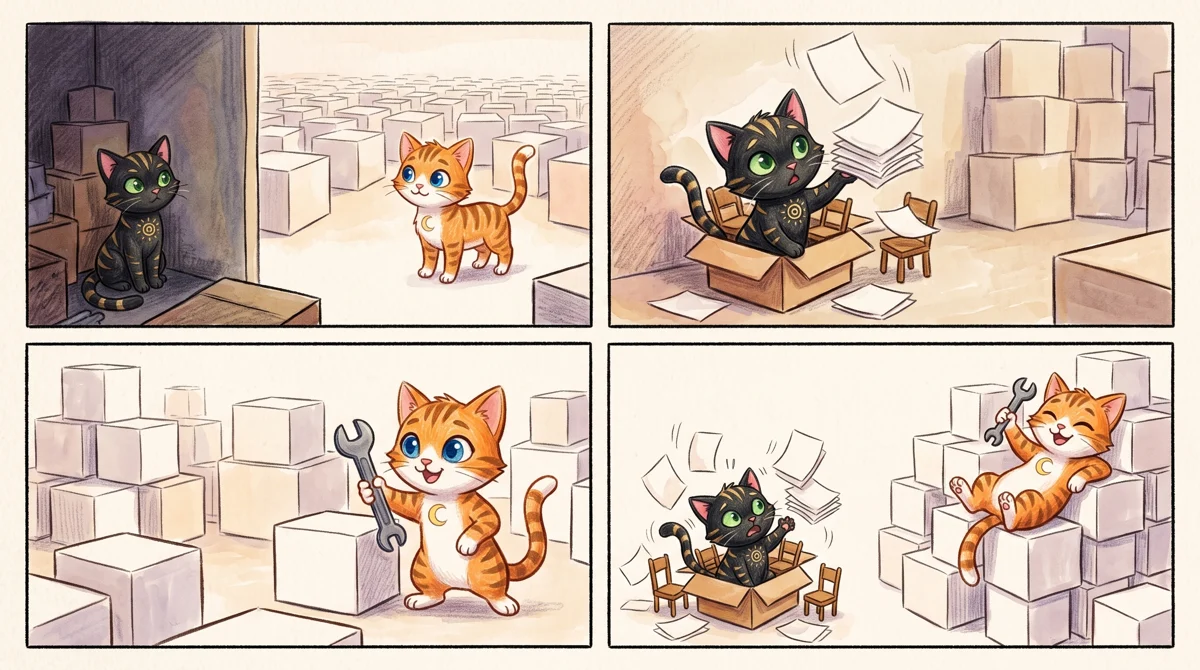
Illustration: The cloud version feels like a tightly cramped box, whereas the self hosted version offers endless space if you build it yourself.
That 1,000-record cap is the number that matters. For a personal CRM, a small inventory list, or a prototype, it holds. For anything with real growth, it does not. You will hit 1,000 rows faster than you think, and the jump from free to paid is not small.
The self-hosted community edition has no record limit. You run it on your own server. You pay for the server, not for NocoDB. That is the real free tier for anyone with technical capacity.
The gap between these two paths is the single most important thing to understand before you sign up. The cloud free plan is a demo with a ceiling. The self-hosted version is a commitment with no ceiling but real operational cost.
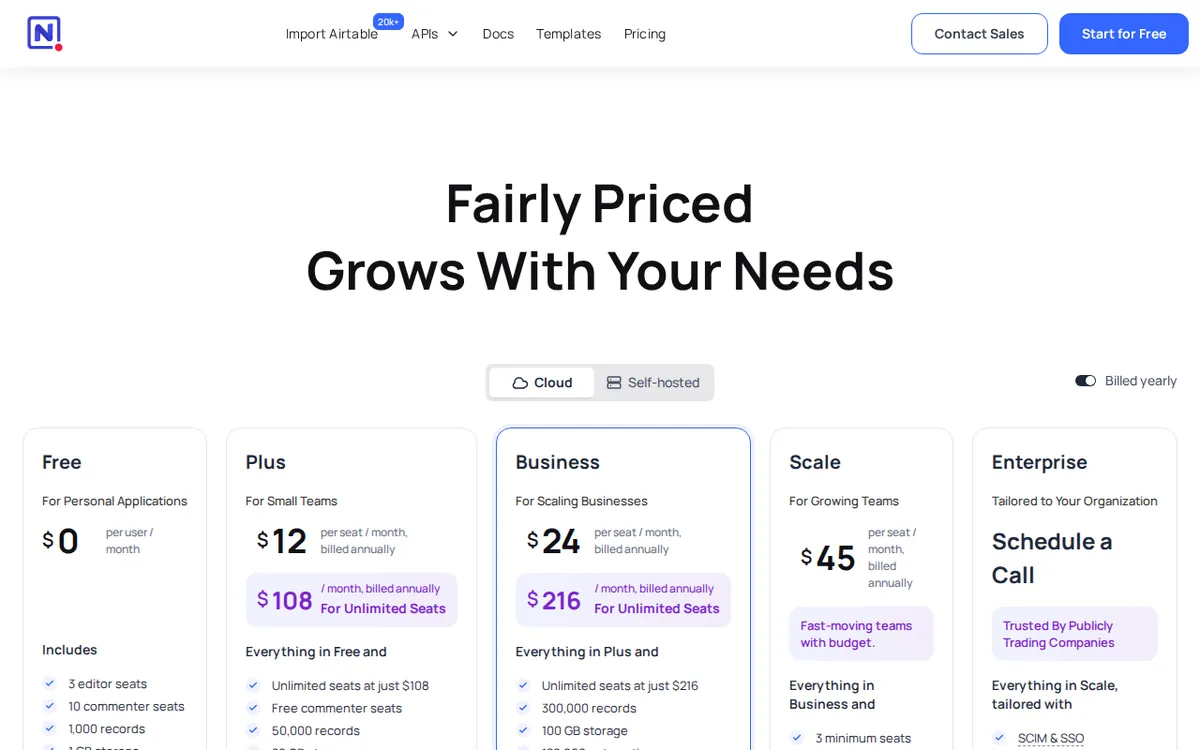
Figure: nocodb.com official pricing page, captured 2026-11-08.
The paid plans and the 9-seat cap
Plus costs US$15 per seat per month on monthly billing, or US$12 per seat per month on annual billing. It includes 50,000 records, 10 GB storage, 5,000 automations, and 50,000 API calls.
Business costs US$30 per seat per month monthly, or US$24 per seat per month annually. It includes 300,000 records, 100 GB storage, 120,000 automations, 1 million API calls, 10 external database connections, and SAML SSO — a standard way for companies to manage logins centrally.
Scale costs US$54 per seat per month monthly, or US$45 per seat per month annually, with a minimum of 3 seats. It includes 1 million records, 150 GB storage, 240,000 automations, 5 million API calls, row-level security (per-user access rules at the row level), and audit logs.
There is a cap protection worth knowing. On Plus and Business, once you pay for 9 seats, the whole team gets unlimited seats. The annual billing cap is US$108 per month for Plus and US$216 per month for Business. That is a real ceiling on cost, not a per-seat treadmill.
Scale has no such cap. It starts at 3 seats and scales per seat.
Prices vary by country; we checked from Taiwan.
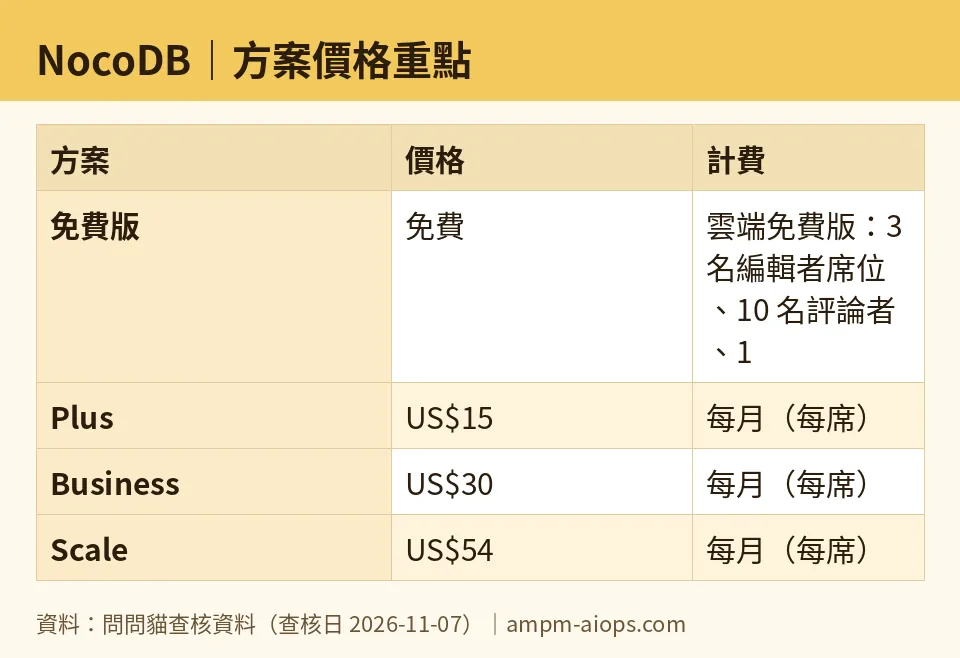
Figure: compiled by AMPM from its verified data (last verified 2026-11-07).
🔍 AMPM exclusive check
Nothing differed from the official page this time; every number below matches it, checked 2026-11-07.
One thing the pricing page does not spell out clearly: the free cloud plan and the self-hosted community edition are not interchangeable. The free cloud plan has a 1,000-record limit. The self-hosted version has no record limit. If you read only the pricing table, you might assume “free” means the same thing on both paths. It does not.
The data also flags that this tool is an auto-ingested challenger candidate. It has been checked once, not triple-verified by hand. The free quota and commercial terms should be confirmed on the official site at the moment you sign up. We verified the numbers on 2026-11-07 and they matched. But the verification history shows daily automated checks from 2026-10-21 through 2026-11-06, all consistent. That is a good sign, not a guarantee.
☀️ AMO, the budget-minded cat

Free is the question. Is it enough, and is paying worth it?
The cloud free plan gives you 3 editors, 10 commenters, 1,000 records, 1 GB storage, 100 automations, and 1,000 API calls per month. For a solo user or a tiny team testing an idea, that is workable. You can build a small database, invite a couple of people, and see if the interface fits how you think.
But 1,000 records is tight. A simple contact list with a few hundred entries plus a project table plus a task table will approach that limit quickly. Once you cross it, you are looking at Plus at US$15 per seat per month, or US$12 per seat per month annually. For 3 editors, that is real money every month.
The self-hosted community edition changes the math. No record limit. No seat limit. You pay for a server, which you might already have. If you can run a Docker container — a packaged app that runs in isolation — you can run NocoDB. That is the budget play. It is not free in effort, but it is free in license.
The 9-seat cap on Plus and Business is the best deal on the paid side. If you have 9 or more people, the annual cap of US$108 per month for Plus or US$216 per month for Business means your cost stops growing. For a 20-person team, that is a strong value. For a 3-person team, it is irrelevant.
Skip paid if you are under 1,000 records and can self-host. Pay if you need the cloud convenience and your team is large enough to hit the 9-seat cap.
🌙 PIMI, the performance-minded cat

Does it actually work well, fast, and do the job?
The paid tiers tell you what NocoDB thinks performance costs. Plus gives you 50,000 records, 10 GB storage, 5,000 automations, and 50,000 API calls. Business jumps to 300,000 records, 100 GB storage, 120,000 automations, 1 million API calls, 10 external database connections, and SAML SSO. Scale goes to 1 million records, 150 GB storage, 240,000 automations, 5 million API calls, row-level security, and audit logs.
The API call limits are the real performance gate. At 1,000 API calls per month on the free plan, any integration that polls regularly will burn through that in days. Plus gives you 50,000, which is 50 times more. Business gives you 1 million. Scale gives you 5 million. If you are wiring NocoDB into other tools, the free plan is not a performance option. It is a trial.
Automations follow the same curve. 100 per month free, 5,000 on Plus, 120,000 on Business, 240,000 on Scale. An automation is a triggered action — when a row is added, send an email, for example. If you rely on those, the free tier will not carry you.
Row-level security and audit logs are Scale-only. If you need per-user access rules or a record of who changed what, you are paying US$54 per seat per month monthly, or US$45 per seat per month annually, minimum 3 seats. That is the price of compliance-grade access control.
The self-hosted community edition has no record limit, but the data does not specify its automation or API limits. That is a gap. If you self-host, verify those numbers yourself before committing a production workflow.
Verdict: who should use it, who should skip it
NocoDB is a strong fit for two groups. First, technical users who can self-host and want no record limit without paying per seat. Second, teams of 9 or more who want the cloud version and can hit the seat cap on Plus or Business, turning per-seat pricing into a fixed monthly cost.
It is a poor fit for non-technical users who need more than 1,000 records on the free cloud plan. The jump to Plus at US$15 per seat per month is steep for a small team, and the free plan’s API and automation limits will frustrate anyone building integrations.
The three genuinely annoying things: the 1,000-record free cloud cap, the 1,000 API calls per month on free, and the fact that row-level security and audit logs are locked behind the US$54 per seat Scale plan. The genuinely good things: the self-hosted option with no record limit, the 9-seat cap that stops cost growth, and the clear jump in quota between tiers.
If you are under 1,000 records and can run a server, self-host. If you are a large team, pay and hit the cap. If you are a small team that needs cloud and will grow past 1,000 records, budget for Plus and check whether the automation and API limits fit your workflow before you commit.
Written: 2026-11-08 Price last verified: 2026-11-07 Tool last health-checked: 2026-11-08
🔗 Related on AMPM
📎 Sources
All prices and quotas in this article come from AMPM’s verified dataset for NocoDB (last verified 2026-11-07); primary sources:
🐾 Meet the cats: AMO and PIMI
AMPM is a Taiwan-based AI-tool pricing watchdog. Our motto: ask before you subscribe. Two cats argue every tool from two sides:
- ☀️ AMO — the budget-minded cat. Always asks: is the free tier enough, and is paying actually worth it?
- 🌙 PIMI — the performance-minded cat. Cares about whether it works well, fast, and gets your job done.
When they are done arguing, you know whether to pay. Every number is checked by us, with the verification date at the end.
🐾 Our sister sites also checked
Read next
- NocoDB Full breakdown: pricing, features and real-world limits
- NocoDB Is the free quota enough?
- NocoDB Alternatives
- Free plan limits for every AI tool we track