[Pricing] Firecrawl Pricing: Is the Free Tier Enough for Real Scraping?
- Free tier: Yes
- Cheapest paid plan: US$19/mo and up
- Free quota: 1,000 credits every month (about 500 searches or 1,000 scraped pages); …
- Last checked: 2026-11-19
Article last updated: 2026-11-16


Firecrawl is a web data API — a service that turns web pages into clean text or markdown that AI agents and apps can read. It scrapes single pages, crawls whole sites, and runs searches. If you are wiring a model to the live web, Firecrawl is one of the usual suspects.
The question is money. Firecrawl has a free tier and four self-serve paid plans, plus an enterprise tier. The free tier looks generous until you count what a search actually costs. The paid plans look expensive until you compare the annual rate to the monthly one. And the cheapest upgrade path is not the one most people assume.
Here is the whole ladder, with the numbers we verified.
What the free tier actually gives you
Firecrawl’s free plan hands you 1,000 credits every month. No credit card. The pool refreshes monthly.
A credit is the unit Firecrawl bills against — different API calls burn different amounts. On the free plan, 1,000 credits is about 1,000 scraped pages or about 500 searches. Read that again: a search costs roughly twice what a page scrape costs. If your agent searches the web more than it reads known URLs, your free month disappears about twice as fast as the page count suggests.
Scrape, crawl, Map, Search and Interact all draw from the same shared pool. There is no separate free allowance per endpoint. The per-endpoint credit costs sit on the official pricing page.
Two conditions matter more than the credit number. The free plan runs at low rate limits and allows 2 concurrent requests — two jobs running at the same time. For a hobby script that is fine. For anything that needs to finish on a schedule, 2 concurrent requests is a queue, and the queue is the real limit, not the credits.
When free credits run out, you either upgrade or wait for the next month. There is no top-up on the free plan. Firecrawl’s own guidance is that production use usually needs Hobby or above.
No watermark. Commercial use is not spelled out in the data we verified, so we will not guess at it.
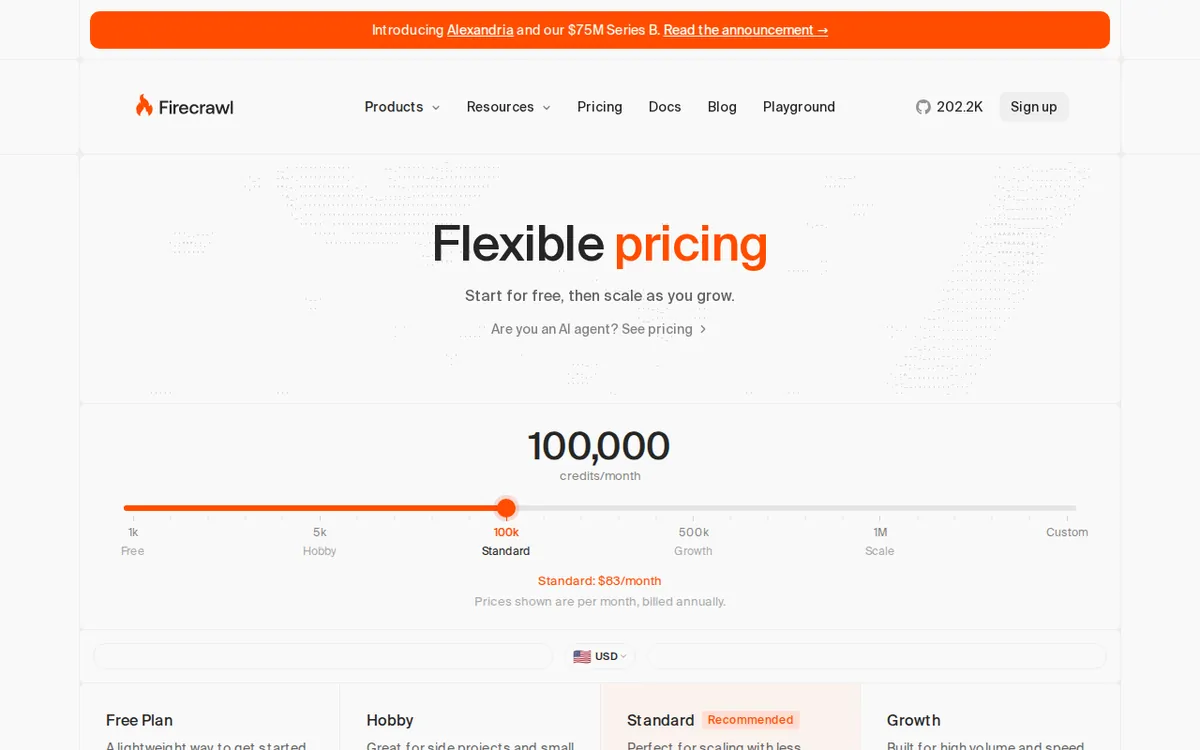
Figure: firecrawl.dev official pricing page, captured 2026-11-16.
The paid ladder, plan by plan
All four self-serve plans bill monthly, and all four list a lower effective monthly rate if you pay annually. Firecrawl does not publish a yearly total on the page we checked — only the effective per-month figure. So we are not going to multiply anything out for you.
Hobby — US$19/month, or US$16/month billed annually. 5,000 credits per month, which is about 2,500 searches or 5,000 pages. 5 concurrent requests. Basic scrape, crawl, map and search. Basic support. Extra credits available. This is the entry paid plan, aimed at side projects and small tools. Standard raises credits from 5k to 100k and concurrency from 5 to 25.
Standard — US$99/month, or US$83/month billed annually. 100,000 credits per month. 25 concurrent requests. Standard support. The pricing page itself recommends this tier. Growth raises credits from 100k to 500k.
Growth — US$399/month, or US$333/month billed annually. 500,000 credits per month. 50 concurrent requests. Priority support. Built for high-volume crawls and higher throughput. Scale raises credits from 500k to 1M and concurrency from 50 to 100.
Scale — US$749/month, or US$599/month billed annually. 1,000,000 credits per month. 100 concurrent requests. Priority support. Also sold through AWS and GCP Marketplace. Above this, you talk to sales.
Enterprise — custom. Custom credits and concurrency, dedicated support and SLA, bulk discounts, zero-data retention, SSO. Pricing is contact-sales only.
One detail worth flagging: extra credits are sold in US$5 increments, and only on paid plans. That is the escape hatch when you blow through a month without wanting to jump a whole tier.
Prices vary by country; we checked from Taiwan.
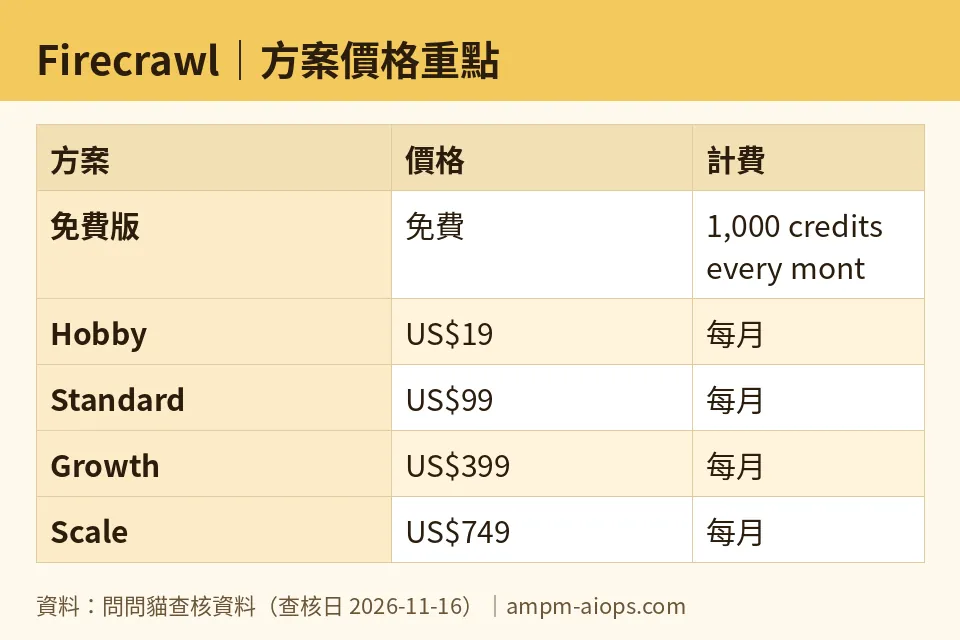
Figure: compiled by AMPM from its verified data (last verified 2026-11-16).
🔍 AMPM exclusive check
Nothing differed from the official page this time; every number below matches it, checked 2026-11-16.
We ran the same comparison daily from 2026-11-04 through 2026-11-16 — thirteen consecutive checks against Firecrawl’s pricing page. No price moved. No quota moved. No plan was added or removed. That stability is itself the finding: if you were quoted a different Hobby or Standard rate in the last two weeks, it did not come from the official page.
The one thing the vendor page does not spell out in a single sentence is the search-versus-scrape cost gap. The free tier is described as 1,000 credits, and separately as roughly 500 searches or 1,000 pages. Put those two statements side by side and the real story appears: search burns credits at about double the rate of a plain page scrape. That is not hidden, but it is easy to miss, and it changes which plan you should pick. A team that mostly scrapes known URLs and a team that mostly searches will land on different tiers at the same monthly spend.
We also confirmed the concurrency numbers, because they are the limit people hit before credits: 2 on free, 5 on Hobby, 25 on Standard, 50 on Growth, 100 on Scale.
☀️ AMO, the budget-minded cat

AMO is the reader who wants to know one thing: is free enough, and if not, is paying worth it?
AMO, here is the honest math. Free gives you 1,000 credits a month, no card, refreshed monthly. If your project scrapes a few hundred pages a month, or runs a couple hundred searches, free is genuinely enough and you should not pay anyone anything. The 2 concurrent request cap will annoy you before the credits do, but for a personal tool it holds.
The moment you cross into daily automated runs, free breaks. Not because 1,000 credits is small, but because a single crawl of a medium site can eat a large slice of it in one go, and then you are dark until the first of next month. Waiting is not a strategy for anything with users.
So the real AMO question is Hobby at US$19/month, or US$16/month billed annually. That is 5,000 credits — five times free — plus concurrency up from 2 to 5. If you are burning through free credits in the first week of every month, Hobby is the correct buy and it is not close. If you are finishing free months with credits to spare, Hobby is wasted money.
The trap is jumping to Standard too early. US$99/month is a 5x step up from Hobby in price and a 20x step up in credits. Most small teams do not need 100,000 credits; they need more than 5,000 and fewer than 100,000, and Firecrawl does not sell that tier. The US$5 extra-credit increments exist precisely for that gap. Buy Hobby, top up with US$5 when you run dry, and only move to Standard when the top-ups cost more than the jump. Do that arithmetic with your own usage before you upgrade.
And skip annual billing until you have three months of real usage data. The annual rate is lower per month, but the data does not give a yearly total, so you are committing blind to a number the page will not show you.
Verdict: who should use it, who should skip it
Use the free tier if you scrape a few hundred pages a month, run occasional searches, and can live with 2 concurrent requests. It costs nothing, needs no card, and refreshes monthly. There is no reason to pay before you hit the wall.
Pay for Hobby if you have hit that wall — free credits gone before month-end, or a queue building behind the concurrency cap. US$19/month, or US$16/month annually, is the cheapest real upgrade and the right one for side projects and small tools.
Pay for Standard if you are running production traffic with steady usage and 25 concurrent requests is a genuine need, not a nice-to-have. The pricing page recommends it; your usage should too.
Skip everything above Standard until your extra-credit top-ups at Hobby or Standard cost more than the next tier. Growth and Scale are for high-volume crawls and team-scale pipelines — if you do not recognize your workload in those words, you are not the buyer.
Skip Firecrawl entirely if you mostly search rather than scrape. The credit math punishes search at roughly double the rate, and a search-heavy workload will make every tier feel half as big as the label says.
Written: 2026-11-16 Price last verified: 2026-11-16 Tool last health-checked: 2026-11-16
🔗 Related on AMPM
📎 Sources
All prices and quotas in this article come from AMPM’s verified dataset for Firecrawl (last verified 2026-11-16); primary sources:
🐾 Meet the cats: AMO and PIMI
AMPM is a Taiwan-based AI-tool pricing watchdog. Our motto: ask before you subscribe. Two cats argue every tool from two sides:
- ☀️ AMO — the budget-minded cat. Always asks: is the free tier enough, and is paying actually worth it?
- 🌙 PIMI — the performance-minded cat. Cares about whether it works well, fast, and gets your job done.
When they are done arguing, you know whether to pay. Every number is checked by us, with the verification date at the end.
🐾 Our sister sites also checked
Read next
- Firecrawl Full breakdown: pricing, features and real-world limits
- Firecrawl Alternatives
- Free plan limits for every AI tool we track