[Pricing] DevCycle pricing: Is the free tier enough for growth?
- Free tier: Yes
- Cheapest paid plan: US$625/mo and up
- Free quota: Free plan is permanently free (no credit card required), offering …
- Last checked: 2026-11-19
Article last updated: 2026-11-19


Overview – the numbers that matter
DevCycle sells a feature‑flag and A/B testing platform aimed at modern dev teams. The service is subscription‑based. Two options exist: a permanent free tier and a single paid “Business” tier. Below we list every quota and price exactly as the vendor shows.
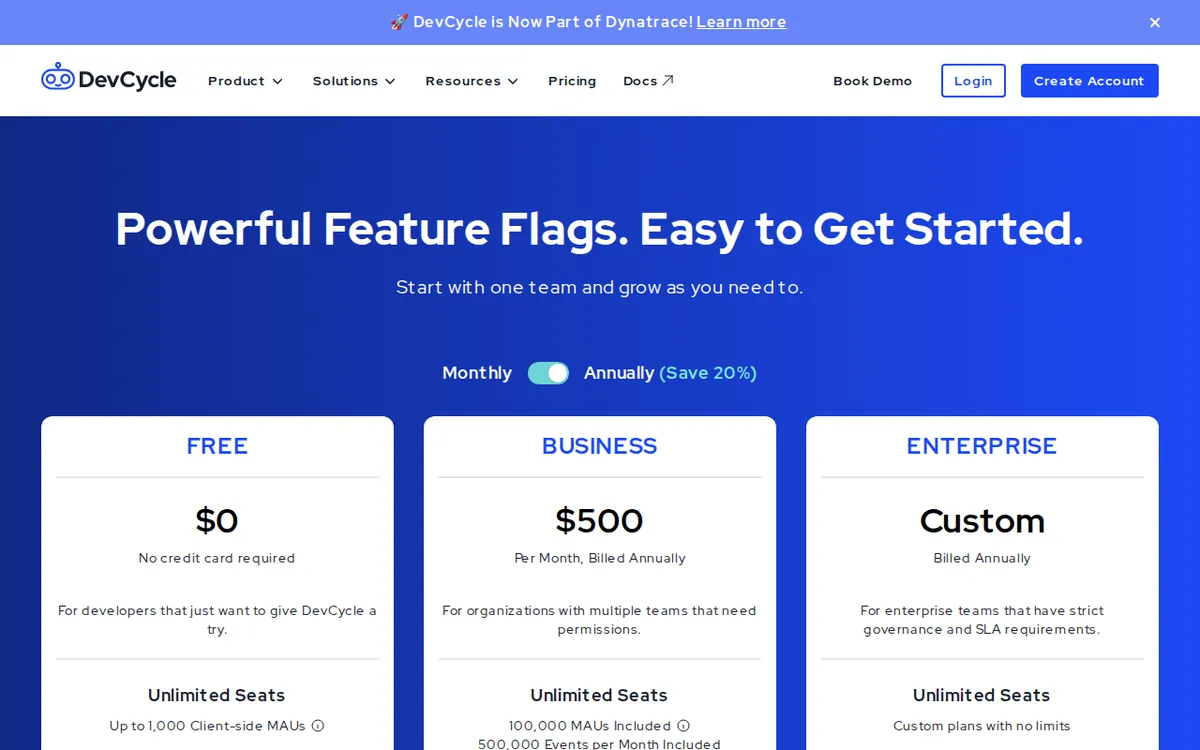
Figure: devcycle.com official pricing page, captured 2026-11-19.
What the free tier actually gives
The free tier is labelled “Free” and does not require a credit‑card. It provides:
- 1,000 client‑side MAUs per month – MAU means a unique end‑user that loads the SDK in a browser or app.
- 10,000 Cloud Config requests per month – calls the cloud to fetch flag configuration.
- 100,000 Server Config requests per month – server‑side SDK calls to evaluate flags.
- 5,000 events per month – custom telemetry such as flag evaluations or experiment outcomes.
There is no limit on team seats (the number of people who can log in to the DevCycle console) and no limit on flag count (the number of feature flags you can define). The free tier also includes built‑in A/B testing and the MCP Server component. All limits reset each month; unused capacity does not roll over.
When the Business plan becomes necessary
The paid Business plan costs US$625 per month on a month‑to‑month contract. An annual commitment is advertised as US$500 per month. The plan adds:
- Unlimited seats – any size team can collaborate.
- Unlimited flags – no cap on how many feature toggles you create.
- 100,000 client‑side MAUs per month – ten times the free tier limit.
- 500,000 events per month – a hundred‑fold increase over the free tier.
If you exceed the MAU quota, the vendor charges US$2.50 for each additional 1,000 client‑side MAUs. The Business tier also unlocks several advanced capabilities: AI‑generated feature summaries and schema, audit logging, expired‑flag detection, EdgeDB custom attribute storage, and custom domain proxy.
There are no other paid tiers listed on the pricing page.
Cost considerations beyond the headline price
The Business tier’s price is a flat monthly figure plus any overage fees. The overage rate applies only to client‑side MAUs; there is no published overage cost for events or server‑side requests. The annual pricing display (US$500 per month) suggests a discount for a 12‑month commitment, but the vendor does not list a separate yearly total.
The free tier’s limits are generous for a small product or early prototype. However, the jump from 1,000 to 100,000 client‑side MAUs is a factor of 100, which can be a steep barrier for rapidly scaling apps.
No hidden fees are mentioned on the pricing page. The vendor states that the free tier is “permanent” and that the Business tier includes all listed features without extra add‑ons.
🔍 AMPM exclusive check
We compared the numbers on DevCycle’s pricing page with the live page on 2026‑11‑16. Every quota and price matches the official source. No discrepancy was found.
☀️ AMO, the budget‑minded cat

AMO looks at the bottom line. The free tier costs free and needs no card. For teams that stay under 1,000 client‑side MAUs, 10,000 cloud config calls, 100,000 server config calls, and 5,000 events, the free tier covers all core use cases. Unlimited seats and flags mean that even a large dev group can experiment without paying.
When a product grows beyond those caps, the next step is the Business plan at US$625 per month (or US$500 per month if you sign up for a year). The overage charge of US$2.50 per 1,000 extra MAUs is modest compared with the jump in base price, but it can add up quickly if traffic spikes.
For startups on a tight budget, the free tier is a solid launchpad. The cost of moving to Business is high relative to the free tier, so AMO recommends evaluating the MAU trend for at least a month before committing. If you can stay under the free limits for six months, the upgrade may be delayed. If you expect to hit 100,000 MAUs within a quarter, the Business tier’s flat price becomes more predictable than paying overage fees.
🌙 PIMI, the performance‑minded cat

PIMI cares about whether the platform can handle real‑world load and deliver the promised features. The free tier’s 1,000 client‑side MAU ceiling is often insufficient for production‑grade releases. The limit on events (5,000) may also constrain detailed experiment tracking, especially when each flag evaluation logs an event.
The Business tier lifts those limits dramatically: 100,000 client‑side MAUs and 500,000 events give ample headroom for mid‑size SaaS products. Unlimited seats and flags remove administrative bottlenecks as teams scale. The added AI‑generated feature summary can speed rollout reviews, while audit logging and expired‑flag detection improve compliance and reliability.
Performance‑wise, the overage model is linear: every extra 1,000 MAUs costs US$2.50. This predictability helps capacity planning. However, the pricing page does not list limits for cloud or server config requests in the Business plan, implying they are unlimited or far above typical usage.
If you need the advanced security and AI features, the Business tier is the only way to unlock them. For a team that already uses other flag services, the performance boost may justify the monthly spend.
Verdict: who should use it, who should skip it
Use DevCycle if:
- You are a small team launching a new product and can stay within 1,000 client‑side MAUs and 5,000 events per month.
- You need unlimited seats and flags without paying.
- You want built‑in A/B testing without additional integration work.
Upgrade to Business if:
- Your projected client‑side MAUs approach or exceed 100,000 per month.
- You require the AI‑generated feature summaries, audit logs, or custom domain proxy.
- Your event volume outgrows the free tier’s 5,000 limit and you need detailed telemetry.
Skip DevCycle if:
- Your product already exceeds the free tier limits but you cannot commit to US$625 (or US$500) per month.
- You need a pricing model that scales more gradually, such as per‑seat or per‑feature pricing.
- You require explicit limits on server‑side config requests, which are not listed for the Business tier.
Written: 2026-11-19
Price last verified: 2026-11-16
Tool last health-checked: 2026-11-19
🔗 Related on AMPM
📎 Sources
All prices and quotas in this article come from AMPM’s verified dataset for DevCycle (last verified 2026-11-16); primary sources:
🐾 Meet the cats: AMO and PIMI
AMPM is a Taiwan-based AI-tool pricing watchdog. Our motto: ask before you subscribe. Two cats argue every tool from two sides:
- ☀️ AMO — the budget-minded cat. Always asks: is the free tier enough, and is paying actually worth it?
- 🌙 PIMI — the performance-minded cat. Cares about whether it works well, fast, and gets your job done.
When they are done arguing, you know whether to pay. Every number is checked by us, with the verification date at the end.
🐾 Our sister sites also checked
Read next
- DevCycle Full breakdown: pricing, features and real-world limits
- DevCycle Is the free quota enough?
- DevCycle Alternatives
- Free plan limits for every AI tool we track