[Pricing] Before You Pay for CircleCI: What the Free Tier Really Covers
- Free tier: Yes
- Cheapest paid plan: US$15/mo and up
- Free quota: The Free plan provides 30,000 free credits per month (approximately …
- Last checked: 2026-11-19
Article last updated: 2026-11-17



CircleCI is a cloud service that builds, tests and ships your code automatically every time you push a change. That category is called CI/CD (continuous integration and delivery). Teams use it so nobody has to run tests by hand.
My angle: CircleCI’s paid plan looks like a simple upgrade, but its base fee buys you the same monthly allowance the free plan already gives you. The real question is what you are paying for on top of that, and when the meter starts running.
Everything below comes from CircleCI’s official pricing page, last verified 2026-11-16. Prices vary by country; we checked from Taiwan.
How CircleCI charges: credits, not seats
Most software charges per seat, meaning per person with a login. CircleCI mostly doesn’t. It bills by usage, and the unit is the credit. A credit is a pre-paid chunk of compute time. Every build burns credits depending on the size of the machine it runs on and how long it runs.
That changes how you compare plans. You are not asking “how many people do we have?” You are asking “how many minutes of builds do we run, and on what machine size?”
There is still a people limit. CircleCI counts active users, meaning people whose code changes actually trigger builds in a month. Someone with an account who never pushes code does not count as active, according to the plan description we read. That is a gentler rule than a classic per-seat price, but it still sets a ceiling on both plans.
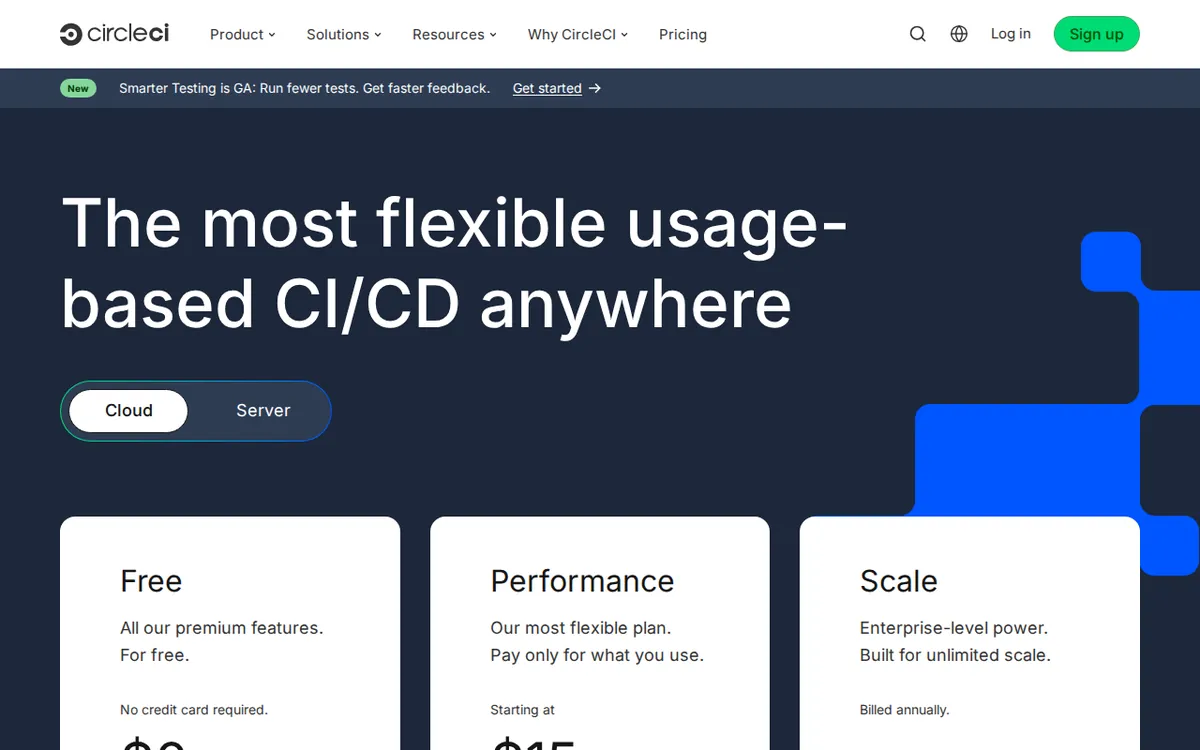
Figure: circleci.com official pricing page, captured 2026-11-17.
The free tier, line by line
The Free plan costs nothing and includes:
- 30,000 credits per month. Credits reset monthly and do not roll over. Unused credits vanish.
- Up to 5 active users.
- 30x parallelism. That means up to 30 jobs can run at the same time, which cuts waiting if you split tests across many machines.
- A basic allowance for open-source projects.
CircleCI’s page gives a rough sense of what 30,000 credits buys. On small Docker machines, it is about 6,000 minutes of compute. On a Medium Linux machine, about 3,000 minutes. Treat both as estimates, not guarantees. Your real number depends on the machine size you pick.
Is that enough? For a small team with a short test suite, probably. Picture five developers pushing several times a day with a test run of a few minutes. You can burn through 3,000 Medium Linux minutes faster than you expect. Slow test suites, big machines and frequent pushes all eat the allowance.
What happens when credits run out on Free? The data we hold does not say, and we did not test it. Check the official page before you rely on the free plan for anything that ships to customers.
The paid plan: Performance
There is one paid plan in our data: Performance, at US$15 per month. It is billed monthly. Our data has no yearly price, so we cannot tell you whether an annual option exists or what it would save. Check the pricing page.
The base fee includes:
- 30,000 credits. The same number the free plan gives you.
- 5 active users. Also the same.
- Up to 80x parallelism. Free caps at 30x.
- Larger compute sizes. These are bigger machines for heavy builds.
Read that list again. The US$15 does not raise your credit allowance or your user count. What it buys is headroom: more parallel jobs, bigger machines, and the right to buy more on top.
The extras are priced like this:
- Extra credits: US$15 for every 25,000 credits.
- Extra active users: US$15 per person per month. Per the pricing page, each added user also deducts 25,000 credits from your balance.
So the plan scales with usage, not with a fixed seat count. That is flexible if your workload is spiky. It is harder to budget if it isn’t.
Cheapest upgrade path
If the free plan is working, the cheapest path is to stay on it. If you hit the credit wall, the path is Performance at US$15 a month, then add credits in 25,000-credit blocks at US$15 each as needed.
If you hit the user wall (a sixth person starting to push code), the cost is US$15 per extra person per month, plus the 25,000-credit deduction. That deduction matters. A new teammate costs you money and shrinks the build allowance for everyone.
When paying is not worth it
Skip Performance if:
- Your builds fit inside 30,000 credits and your team is five active people or fewer.
- You don’t need more than 30 jobs running at once. Few small teams do.
- You don’t need bigger machines. Standard small and Medium sizes cover most web apps.
- You only want the plan to “get more credits.” It doesn’t, until you buy blocks.
Pay if:
- You need parallelism above 30x to keep pipelines fast.
- Your builds need larger machines.
- You regularly overshoot the monthly credits and want a predictable way to buy more.
🔍 AMPM exclusive check
Nothing differed from the official page this time. The credit allowance, user limit, parallelism caps and the US$15 prices all match what CircleCI shows, checked 2026-11-16.
Two limits on our check, so you can weigh it properly:
- One pass only. CircleCI entered our tracker recently. Its data has been read from the official pricing page and re-checked daily for drift, but we have not yet cross-checked it against independent sources by hand.
- Commercial terms not verified. We did not confirm how the free plan treats commercial use, and we did not test what happens at the credit limit.
The minute conversions (about 6,000 and 3,000) are CircleCI’s own approximations. We did not benchmark them.
☀️ AMO, the budget-minded cat

AMO’s question is blunt: is free enough, and is paying worth it?
On free, you get 30,000 credits a month, 5 active users and 30x parallelism. That is roughly 6,000 small-Docker minutes or 3,000 Medium Linux minutes. For a hobby project, a student team or a small startup with quick tests, that can last the whole month. AMO would stay here and watch the credit counter.
On paid, the first thing AMO notices is that US$15 a month does not add a single credit. Performance includes the same 30,000 credits and the same 5 users. You are paying for 80x parallelism, larger machines, and the ability to buy more. Extra credits come in blocks of 25,000 for US$15. Extra users cost US$15 each per month and deduct 25,000 credits.
So AMO’s rule is simple. Do not pay the US$15 just to feel safer. Pay when one of three things is true: you are waiting too long on builds and need more parallel jobs, your builds need bigger machines, or you keep running dry before the month ends. In the third case, the base fee is the entry ticket, and each 25,000-credit block is the real cost. Estimate how many blocks you would need before you commit, because the bill grows with usage.
AMO’s verdict: free first, upgrade only when a specific limit hurts.
Verdict: who should use it, who should skip it
Use the free plan if you are a solo developer, a small team of up to five active people, or an open-source maintainer. Keep an eye on the credit counter in the first month and see how close you get.
Move to Performance if build speed is costing you real time, your jobs need larger machines, or you consistently exhaust the monthly credits. Budget for extra 25,000-credit blocks, not just the US$15 base.
Skip it, or look at a rival, if your team is bigger than five active people and your builds are light. Each extra user costs US$15 a month and eats into your credits. Also skip it if you need a fixed yearly price. Our data shows only a monthly one.
Last step before you decide: open the official pricing page and run your own numbers. Count your pushes per day, your average build minutes and your machine size. Then compare against 30,000 credits.
Written: 2026-11-17 Price last verified: 2026-11-16 Tool last health-checked: 2026-11-17
🔗 Related on AMPM
📎 Sources
All prices and quotas in this article come from AMPM’s verified dataset for CircleCI (last verified 2026-11-16); primary sources:
🐾 Meet the cats: AMO and PIMI
AMPM is a Taiwan-based AI-tool pricing watchdog. Our motto: ask before you subscribe. Two cats argue every tool from two sides:
- ☀️ AMO — the budget-minded cat. Always asks: is the free tier enough, and is paying actually worth it?
- 🌙 PIMI — the performance-minded cat. Cares about whether it works well, fast, and gets your job done.
When they are done arguing, you know whether to pay. Every number is checked by us, with the verification date at the end.
🐾 Our sister sites also checked
Read next
- CircleCI Full breakdown: pricing, features and real-world limits
- CircleCI Is the free quota enough?
- CircleCI Alternatives
- Free plan limits for every AI tool we track