[Pricing] Cartesia Free Tier Limits: When Does Commercial Use Force an Upgrade?
- Free tier: Yes
- Cheapest paid plan: US$5/mo and up
- Free quota: Free plan: 20,000 Model Credits per month (approximately 20,000 …
- Last checked: 2026-11-19
Article last updated: 2026-11-19


Cartesia sells a voice model that streams speech with very low delay, plus a platform for building voice agents — programs that talk to callers or users in real time. If you are evaluating it, the pricing page answers the easy question (what each plan costs) and dodges the harder one: what the free tier legally lets you do with the audio you generate.
That gap is the whole story here. The free plan is generous on paper. It is also restricted to personal and non-commercial evaluation. Those two facts sit next to each other on the same page, and most readers skim past the second one.
The free tier is a demo with a license attached
Cartesia’s Free plan gives you 20,000 Model Credits per month. Credits are the unit the platform bills against; for text-to-speech, 20,000 credits works out to roughly 20,000 characters of generated speech. You also get US$1 of Voice Agent usage, and access to the Sonic-3 TTS model.
Read the qualifier again: personal and non-commercial evaluation only. That is not a soft suggestion. It means a freelance client deliverable, a monetized YouTube video, or a voice feature inside a company product all sit outside the free tier’s terms. The moment your output earns money or ships inside something that does, you need the commercial license that starts on Pro.
This is the single most expensive misunderstanding a new user can make. Generating a few thousand characters costs nothing. Generating them for a paying client and getting caught is a different kind of bill.
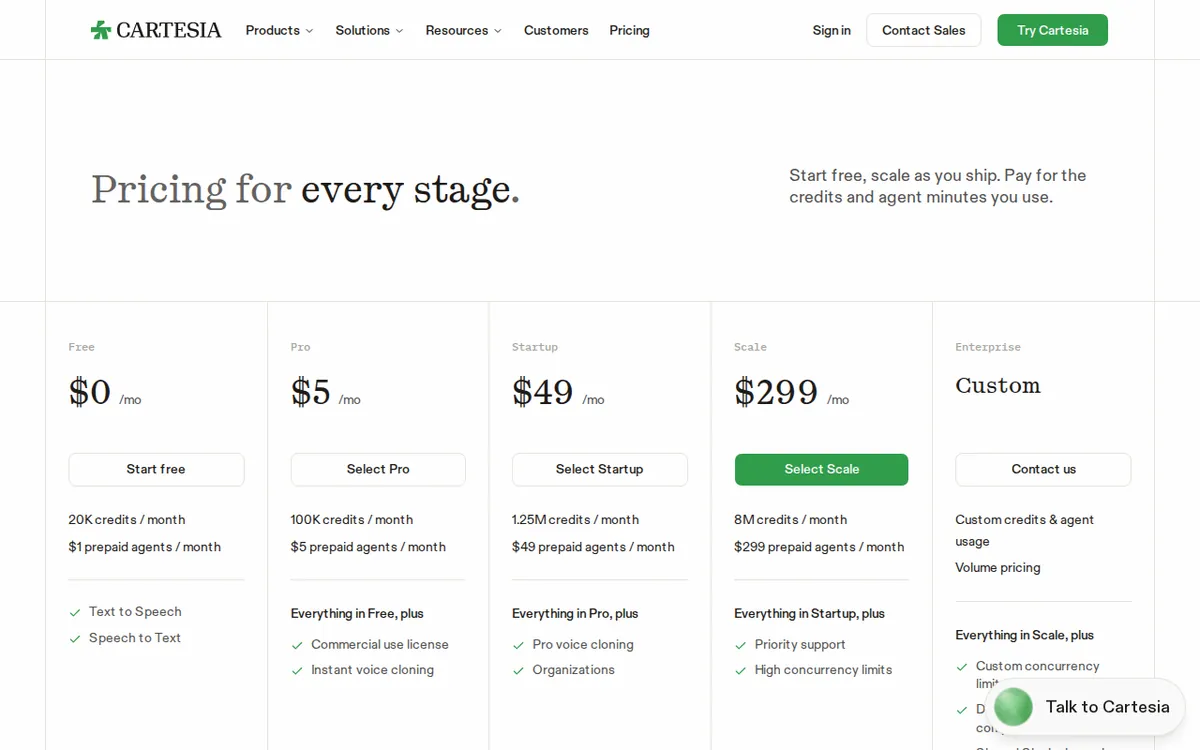
Figure: cartesia.ai official pricing page, captured 2026-11-19.
The paid ladder is short and the first rung is cheap
Cartesia runs three paid plans, all billed monthly at list price, with a lower effective rate if you pay yearly.
Pro — US$5/month (yearly billing averages US$4/month). Includes 100,000 Model Credits per month, US$5 of Voice Agent prepaid usage, Instant Voice Cloning, and commercial licensing.
Startup — US$49/month (yearly averages US$39/month). Includes 1,250,000 Model Credits per month, US$49 of Voice Agent prepaid usage, professional voice cloning, an organization workspace, and team API keys.
Scale — US$299/month (yearly averages US$239/month). Includes 8,000,000 Model Credits per month, US$299 of Voice Agent prepaid usage, higher concurrent request limits, and priority technical support.
An API key is the credential your software uses to call Cartesia’s servers. Concurrent requests are how many calls the system handles at the same instant.
Notice the shape of the ladder. Pro to Startup is roughly a tenfold jump in price for a twelve-and-a-half-fold jump in credits. Startup to Scale is roughly six times the price for 6.4 times the credits. The middle plan is where the credit-per-dollar ratio improves most, but US$49 is a real commitment for someone who just wants to test a voice on a side project.
The cheapest upgrade path is Pro at US$5/month, and it is the only plan that flips the commercial-use switch. Nothing between free and Pro exists.
What the pricing page does not put in one sentence
Cartesia does not publish a yearly total anywhere in the data we verified. The yearly figures appear only as monthly averages. If you want to know what a year of Pro actually costs, the page will not tell you in a single number, and we will not compute one for you here — the monthly average is what the vendor states, and that is what we report.
Prices also vary by country. We checked from Taiwan, and the figures above are the US$ list prices shown at verification time.
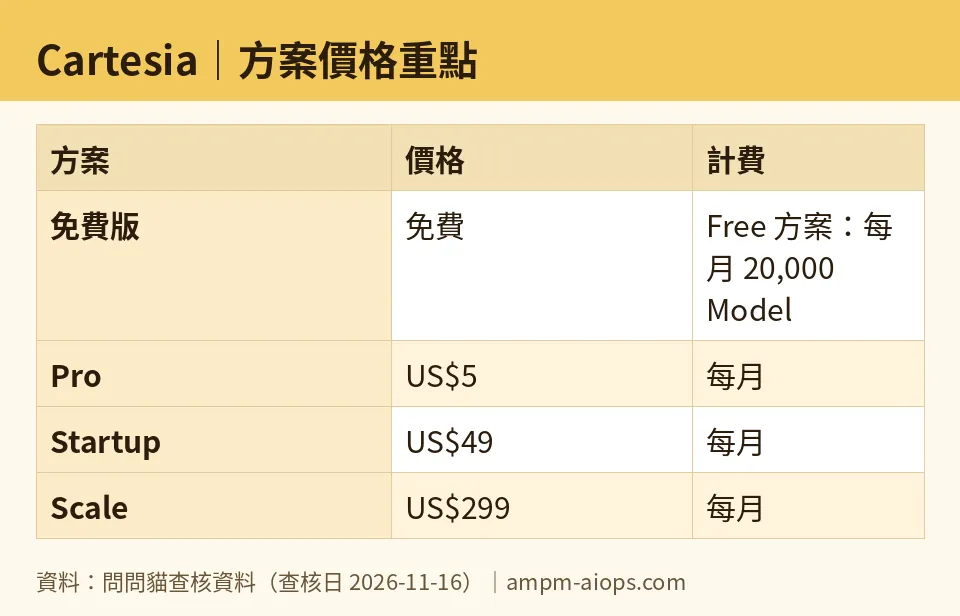
Figure: compiled by AMPM from its verified data (last verified 2026-11-16).
🔍 AMPM exclusive check
Nothing differed from the official page this time. Every price, credit count, and plan inclusion below matches the vendor’s own pricing page as read on 2026-11-16, and the numbers held steady across automated re-checks on 2026-11-14 and 2026-11-15.
One thing worth stating plainly, because the vendor page does not spell it out in a single line: the free tier’s non-commercial restriction and the Pro plan’s commercial license are the same fact viewed from two sides. There is no middle option, no one-off commercial add-on, and no per-project license. If your use is commercial, your entry price is Pro.
We also flag our own confidence level honestly. This tool entered our database as an automatically queued challenger. The data has been through one verification round, not a three-way manual cross-check. Free-tier quotas and commercial terms should be confirmed on the vendor’s site at the moment you sign up.
☀️ AMO, the budget-minded cat

Here is the question I actually care about: is free enough, and if not, is US$5 worth it?
Free gets you 20,000 credits a month, which is about 20,000 characters of speech, plus US$1 of Voice Agent usage. For a hobbyist testing whether Cartesia’s latency claims hold up, that is a real allowance. You can build a small prototype, hear the voice quality, and decide. You pay nothing.
But free is not a small version of Pro. It is a different legal category. Personal and non-commercial evaluation only. The instant you take a freelance gig, monetize a channel, or embed the voice in a product your employer sells, free stops being an option — not because you ran out of credits, but because you were never licensed for that use.
So the honest budget math is this: if your work is commercial, your real entry price is US$5/month, not free. That is the cheapest commercial license on the ladder by a wide margin. Pro gives you 100,000 credits — five times the free allowance — plus US$5 of Voice Agent prepaid usage and Instant Voice Cloning. For a solo creator shipping client work, US$5 is close to trivial against the cost of a licensing dispute.
Where paying is not worth it: you are purely experimenting, nothing you generate earns money or ships in a commercial product, and 20,000 credits covers your testing. Stay on free. Do not upgrade out of habit.
The trap is the middle. If you are commercial but small, do not jump to Startup at US$49 because the credit number looks safer. Pro’s 100,000 credits is five times free. Measure your actual monthly character output before you climb.
🌙 PIMI, the performance-minded cat
Free is not just a license restriction. It is a capability ceiling, and that matters if you care whether the thing actually works.
On free you get the Sonic-3 TTS model and US$1 of Voice Agent usage. That US$1 is the part performance-minded users should stare at. Voice agents are conversational — they listen, generate, and speak in a loop. US$1 of agent usage will not carry a serious load test. You cannot stress a real-time conversation system on a budget that small, which means free tells you almost nothing about how Cartesia behaves under sustained concurrent traffic.
Instant Voice Cloning sits behind Pro at US$5/month. If your product depends on a custom voice, free cannot even evaluate that feature. You are buying blind until you pay.
The real performance tiers are Startup and Scale. Startup at US$49/month brings 1,250,000 credits and team API keys — that is where you can run parallel tests and see whether the low-latency claim survives real concurrency. Scale at US$299/month brings 8,000,000 credits, higher concurrent request limits, and priority support. Higher concurrency limits are the number that decides whether a live voice product holds up when many callers arrive at once. If your traffic is bursty, that limit is the plan.
My read: free is a quality demo, not a load test. Pro is a licensing fix with a modest credit bump. Startup is the first plan where you can honestly evaluate performance at scale. Budget for Startup if you are building anything real, and treat Scale as the answer to a concurrency problem you have actually measured, not one you imagine.
Verdict: who should use it, who should skip it
Use the free tier if you are experimenting, nothing you make is commercial, and 20,000 credits a month covers your testing. It costs nothing and the Sonic-3 model is there to try.
Pay for Pro at US$5/month the moment your use turns commercial, or the moment you need Instant Voice Cloning. It is the cheapest commercial license Cartesia sells, and there is no way around it.
Move to Startup at US$49/month when you need team API keys, professional voice cloning, or enough credits and concurrency to test a real product. Consider Scale at US$299/month only when you have measured a concurrency or support problem that Startup cannot absorb.
Skip Cartesia entirely if you need a free commercial license. It does not offer one, and no plan below Pro grants commercial rights.
Written: 2026-11-19 Price last verified: 2026-11-16 Tool last health-checked: 2026-11-19
🔗 Related on AMPM
📎 Sources
All prices and quotas in this article come from AMPM’s verified dataset for Cartesia (last verified 2026-11-16); primary sources:
🐾 Meet the cats: AMO and PIMI
AMPM is a Taiwan-based AI-tool pricing watchdog. Our motto: ask before you subscribe. Two cats argue every tool from two sides:
- ☀️ AMO — the budget-minded cat. Always asks: is the free tier enough, and is paying actually worth it?
- 🌙 PIMI — the performance-minded cat. Cares about whether it works well, fast, and gets your job done.
When they are done arguing, you know whether to pay. Every number is checked by us, with the verification date at the end.
🐾 Our sister sites also checked
Read next
- Cartesia Full breakdown: pricing, features and real-world limits
- Cartesia Is the free quota enough?
- Cartesia Alternatives
- Free plan limits for every AI tool we track